Do you feel like your business is falling behind because you have not pushed the button on automation yet? Many leaders look at the tech landscape and feel overwhelmed. You see big corporations spending millions on custom models, and you wonder if there is a place for you in this new era. The truth is that you do not need a massive budget to win. You need a plan.
Why AI Counts for SMBs in 2026
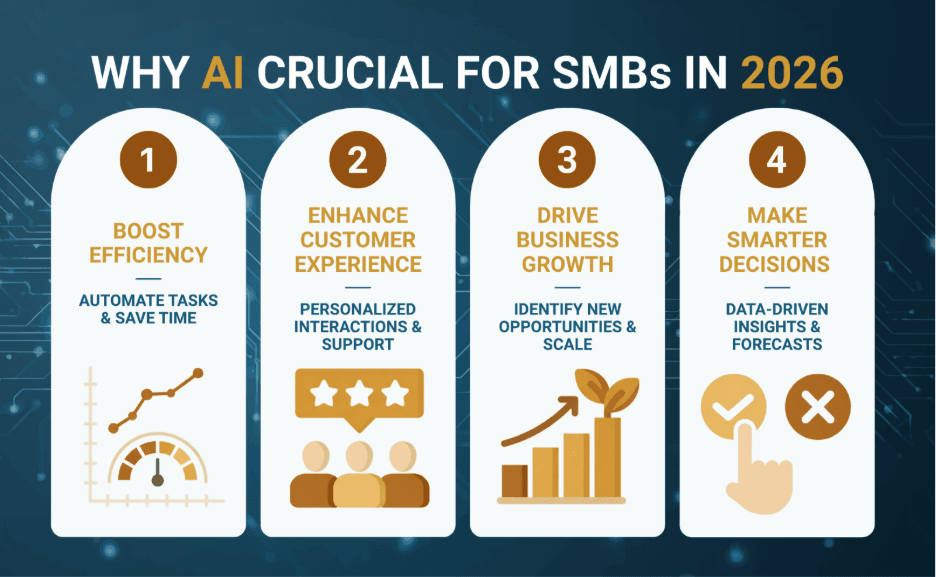
AI sits in tools like email drafts, CRM notes, and support replies. In 2025, ~58% of U.S. small businesses reported using generative AI tools in their operations. SMB AI adoption rewards teams that pick one workflow, set a baseline, and track results.
In 2026, teams will also use AI to tighten quoting, speed up internal reporting, and reduce back-and-forth on routine requests. The SMBs that win keep AI close to daily work, not side experiments, so staff trust the outputs. Clear roles, clean data, and simple guardrails keep scale smooth and predictable.
When you apply the right AI considerations for SMBs, AI implementation for SMBs becomes part of weekly operations.
Key AI Considerations SMBs Must Evaluate
Start with decisions: the workflow to improve, the data to use, and the rules that keep outputs safe. These AI considerations for SMBs keep SMB AI adoption structured.
1. Assessing AI Readiness
Readiness starts with three questions: What outcome do we want? What data feeds that outcome? Who owns the workflow and the data?
Use an AI readiness checklist for SMBs that covers goal, data sources, system access, people capacity, and guardrails. Then choose one workflow, define inputs and outputs in one sentence, and set a KPI. That sentence anchors your AI strategy for small businesses and keeps AI implementation for SMBs focused. This is one of the simplest AI considerations for SMBs to apply.
At Consltek, we align the workflow to business goals first, then we map the operating model around it so teams keep control.
2. AI Costs and ROI
AI spend includes more than licenses. You pay for integration work, access controls, training, and tuning. Put the Cost of AI adoption for SMB into three buckets: platform, rollout, and oversight. Tie value to a baseline. Pick one KPI per workflow, then measure change against that KPI. Use AI ROI for SMBs to track time saved, error reduction, and throughput increase.
Run AI ROI for SMBs monthly. Plan the Cost of AI adoption for SMB up front, and your AI strategy for small businesses stays aligned to margin and capacity.
3. Data Privacy, Security & Governance (GRC)
AI can only work well when your data stays protected, access stays controlled, and decisions stay traceable. This GRC layer keeps AI use aligned to your security posture, customer promises, and audit needs. It also gives teams clear rules on what data can enter AI tools, who can approve new use cases, and how you review outputs over time.
AI-driven cybersecurity risks
Treat Cybersecurity considerations with AI as standard security work. AI-driven cybersecurity risks often show up in prompt handling, access control, and vendor storage practices. Set an approved-tools list, block sensitive data types, and log key workflows.
Call out AI risks for SMBs like shadow AI use and uncontrolled prompt sharing. Reduce AI risks for SMBs with role-based access, SSO, and a short “what not to paste” policy. Keep Cybersecurity considerations with AI in onboarding so new hires follow the same rules.
Compliance (GDPR/DPDP/Audit readiness)
US SMBs can still face GDPR, DPDP, and CCPA pressure through customers and vendors. Keep AI compliance for SMBs simple: map data categories, record where each category lives, and document how AI workflows use it. Keep one short policy for approvals and retention so AI compliance for SMBs stays consistent.
Governance frameworks for Responsible AI
AI governance for small businesses needs ownership, not committee overload. Assign an executive sponsor, a workflow owner, and a security owner. Review performance and cost each month.
Use Responsible AI implementation rules that fit your size, and document who signs off on high-impact outputs. State your AI governance for small businesses rules in one page so teams can follow them. Also protect Data privacy in AI for SMB with data classification rules that staff can apply fast, then repeat the same rule in training so Data privacy in AI for SMB stays consistent.
At Consltek, we build these guardrails into the rollout so teams keep visibility into risk and spend without adding process weight.
4. Vendor & Technology Evaluation
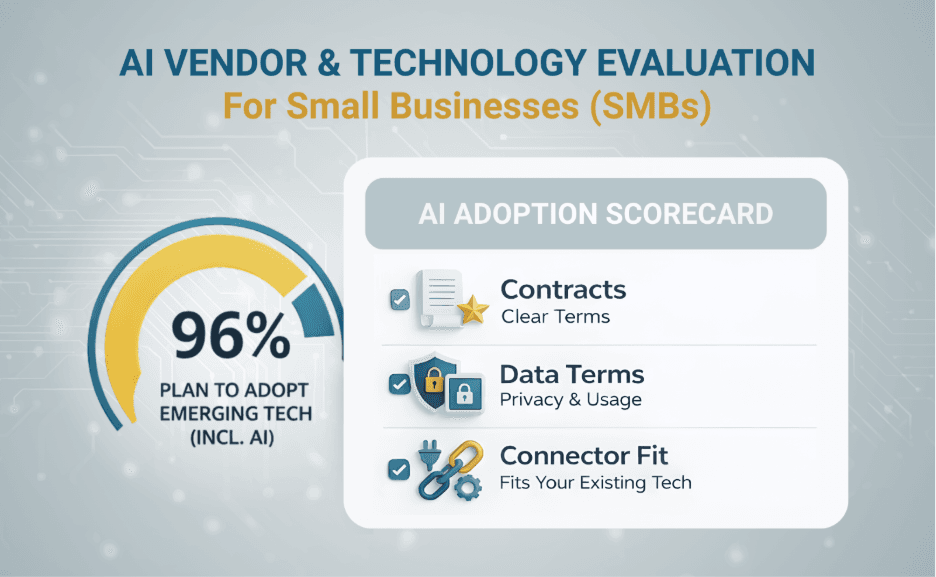
Vendor fit decides adoption. AI vendor selection for SMBs should focus on contracts, data terms, and connectors that match your stack.
96% of small business owners plan to adopt emerging technologies, including AI, in the near future, so keep a short scorecard in your AI strategy for small businesses.
Choosing trustworthy AI vendors
Ask direct questions during AI vendor selection for SMBs: Do you store prompts, and for how long? Can we disable training on our data? Do you support SSO, RBAC, and audit logs?
Use these checks:
- Data terms and prompt retention in plain language
- Security controls like SSO, RBAC, logging, and encryption
- Support terms that match your response-time needs
Open-source vs proprietary AI
Open-source can bring flexibility, but your team carries hosting and patching work. Proprietary platforms can speed setup, but you need strong data terms and exit options.
Integration with existing tech stack
AI integration with existing systems decides whether AI blends into daily work. Confirm connectors for CRM, ticketing, finance tools, and document tools, then test permissions end to end. Build this into AI implementation for SMBs from the pilot stage.
5. Ethical & Responsible AI
Ethical AI for small and medium businesses protects trust with customers and employees. Classify where AI can assist and where humans must decide. For hiring, eligibility decisions, healthcare guidance, and student services, keep humans in the loop. Ethical AI for small and medium businesses also needs transparency through labels and escalation rules, backed by Responsible AI implementation standards.
6. Workforce Training & Change Management
People create SMB AI adoption. Tools do not. Business leaders rank skills shortages as a top barrier, with ~46% citing lack of AI skills as a key challenge. Treat training as part of AI implementation for SMBs.
Keep training short and role-based:
- Prompt templates that fit each team’s workflow
- Data rules and escalation steps in one page
- A feedback loop that captures weak outputs and fixes
AI Adoption Checklist for SMBs
This checklist keeps AI considerations for SMBs visible during rollout. Use it before contracts, after the pilot, and each time you add a new use case. It also acts as your second reference point for an AI readiness checklist for SMBs.
Common AI Implementation Mistakes to Avoid
These guardrails protect results and time:
- Over-automation: start with assistive use, then automate after you trust outputs
- Ignoring data quality: fix key fields and definitions before you expand
- Choosing tools before business problems: pick the workflow first, then the tool
- Underestimating controls: plan security and compliance from day one
When you treat these points as simple operating rules, your rollout stays clean and predictable. Teams build trust in outputs faster because you scale only what works. Over time, this keeps AI implementation steady, secure, and tied to real business targets.
A Responsible Path Toward AI Adoption for SMBs
AI does not need to feel complicated or out of reach for small and mid-sized businesses. The companies that get real results are not the ones chasing every new tool. They are the ones that start with one clear business problem, choose the right use case, and put simple guardrails around how the tool is used. That approach helps teams save time, improve consistency, and make better use of the systems they already have.
The strongest AI rollouts usually begin with readiness, not software. When you understand your goals, data, costs, security needs, and team capacity, it becomes much easier to choose tools that fit your business instead of creating more confusion. That is what turns AI from a trend into something practical and useful.
If your business wants to explore AI in a way that feels structured, secure, and realistic, Consltek can help. Talk to Consltek today to create a practical AI adoption roadmap that supports growth, protects your business, and helps your team use AI with confidence.
FAQs
1. What is the first step SMBs should take when exploring AI?
Start with assessing AI readiness. You must look at your business goals, your data maturity, and your existing tools. You also need to evaluate if your workforce is prepared for the transition.
2. How can small businesses evaluate the ROI of AI implementation?
Focus on measurable KPIs. Track the reduction in manual work hours and the increase in productivity. Compare these gains against the total cost of the software and training.
3. Are there cybersecurity risks when SMBs adopt AI?
Yes. Adoption introduces unique risks like data leakage and privacy exposure. This makes strong governance and a focus on security essential for every project.
4. Do SMBs need a dedicated AI team to get started?
Not necessarily. Many tools are user-friendly and require little technical skill. However, you still need expert oversight to manage the security and compliance aspects.
5. What compliance issues should SMBs consider when using AI?
You must prioritize data protection laws like GDPR or CCPA. You also need an internal framework to ensure your use of technology stays within legal boundaries.
6. What are the steps that SMBs should follow to select the appropriate AI vendor?
Test their security procedures and certification on compliance. Find a partner that provides transparency in their models and has good margins of integration.
7. What can SMBs do to make use of AI in an ethical and responsible manner?
Introduce policies that are geared towards transparency and bias detection. Train your team on a regular basis and make sure that there is always someone to ensure that the machine produces output.
Need Expert Help?
Schedule a consultation with our team to discuss your specific security needs.
Book a Free Consultation