If you own compliance at an SMB, then AI probably did not wait for your approval before joining your workflows. In fact, AI compliance pitfalls are showing up faster than most teams can track them.
For instance, someone used AI to draft an email. Meanwhile, another summarized a customer record. Then, a manager scanned a contract. Also, HR tested it on a policy file. Now, you may be the one asked to explain the risk, the controls, and the audit trail.
Very fair. Very relaxing.
The numbers back this up. According to IBM’s 2025 Cost of a Data Breach Report, one in five organizations has faced a breach tied to shadow AI, and these incidents cost about $670,000 more than standard breaches. So, the gap is real, and it is widening.
In this blog, then, we break down the top AI compliance pitfalls SMBs face. More importantly, we show how to cut risk without turning useful AI into office contraband.
Why AI Compliance Failures Are Accelerating for SMBs
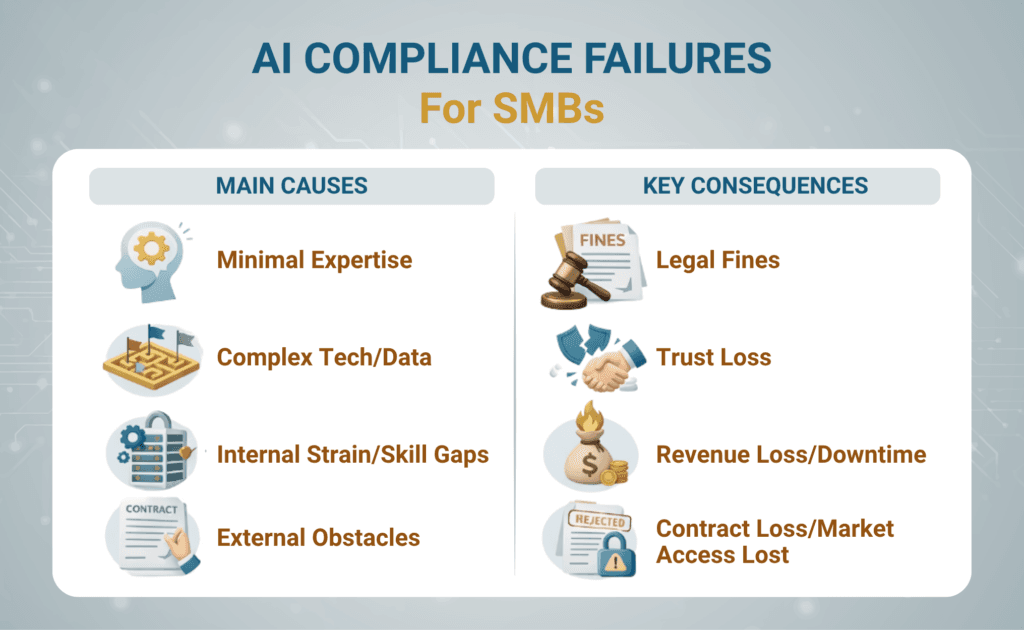
SMBs now use copilots and chat assistants across daily work. As a result, AI use cases pull from systems that already carry legal duties, such as HR files, payment data, and client contracts.
Meanwhile, privacy rules keep changing. Likewise, AI guidance is expanding through frameworks like the NIST AI Risk Management Framework. Also, the ConnectWise State of SMB Cybersecurity Report shows that 83% of SMBs say AI raises their threat level, yet only 51% have any AI security policy in place.
For compliance owners, however, the bigger issue is proof. So, if someone asks what data was entered into an AI system or who approved it, then the business needs an answer.
The Top 10 AI Compliance Pitfalls SMBs Must Avoid
These AI compliance pitfalls show up in audits, incidents, and vendor disputes. However, fixing them does not have to slow growth.
1. No Clear AI Usage Policy
Teams often start with “try it.” At first, that sounds harmless. However, soon someone pastes client text into a public tool. Therefore, a useful policy should define approved tools, blocked data, review steps, and exception handling. For policy support, Consltek’s General GRC Consulting can help shape these rules.
2. Poor Data Governance
AI workflows move data across apps. However, without a map, you cannot control the path. In fact, around 54% of shadow AI tools have been used to upload sensitive company data, according to Reco AI.
So, create a simple AI data flow map for each use case. Then, apply Data Loss Prevention controls. In other words, treat the prompt box like a data exit point, because sometimes it is one.
3. Ignoring Privacy Rules
AI can summarize protected data and create profiles. So, before high-risk use begins, run a short privacy review. Specifically, confirm what data is involved, where the vendor stores it, and how long records are kept.
Also, review data residency and subprocessors. As a result, this step lowers legal risk during audits.
4. Skipping Human Review
AI can draft, rank, and recommend. Unfortunately, however, it can also be wrong with great confidence. Therefore, set review rules by risk level. For example, for high-impact decisions like hiring or pricing require a named reviewer and a short record of the reason.
In short, this is the evidence trail you need when someone asks, “Who decided this, and why?”
5. Misclassified Risk Levels
Many SMBs treat every AI use case the same. However, that creates two problems. On one hand, low-risk tasks get too much friction. On the other hand, high-risk tasks may not get enough control.
So, create a three-tier model:
| Risk tier | Example | Required controls |
| Low | Drafting public blog ideas | Approved tool, basic training |
| Medium | Summarizing internal tickets | Approved tool, data map, output review |
| High | Reviewing HR or contracts | Privacy review, human approval, logging |
For tiered work, Consltek’s IT Risk Management service maps directly into this model.
6. Weak Access Controls
AI tools often sit outside core identity systems. From a compliance view, that leaves a messy trail. In fact, Reco AI reports that 97% of organizations with AI-related breaches lacked basic access controls.
Therefore, use single sign-on (SSO), multifactor authentication (MFA), and role-based access. Also, review API keys often. As a result, these steps make audits less painful.
7. Missing Audit Trails
Auditors ask simple questions. For example, who accessed the data? Also, which outputs reached customers? However, those questions become hard when logging is weak.
Therefore, turn on logs for prompts, outputs, uploads, approvals, and admin actions. Then, decide retention periods.
8. Unsecured Cloud Workflows
Most AI workflows run on cloud apps like Microsoft 365, Salesforce, and HubSpot. Because of that, security must cover the full workflow.
So, review connectors before teams turn them on. Also, check third-party app permissions. Next, use conditional access and secret scanning. For more, Consltek’s Securing AI in Your Business guide walks through the SASE layer.
9. Untrained Staff
Policy does not change behavior on its own. Instead, people need examples from their real work. In fact, shadow AI research shows that only 32% of employees have received formal AI training.
Therefore, run short monthly training with real use cases. For example:
- Safe: “Rewrite this public product description in a clearer tone.”
- Risky: “Summarize this client contract with names and pricing included.”
- Safer: “Summarize this redacted contract after identifiers are removed.”
As a result, this cuts misuse and shadow AI risks.
10. No Continuous Monitoring
Vendors ship updates. Meanwhile, new connectors appear. Likewise, teams change workflows. So, risk moves, even when the policy stays still.
Therefore, a monthly governance loop can help.
In short, this loop helps SMBs avoid AI compliance pitfalls in daily operations, not just during audit season.
How SMBs Can Prevent AI Compliance Pitfalls
You do not need an enterprise budget to run a strong AI governance program. However, you do need aligned security, compliance, and risk work.
After all, the goal is not another policy document in a folder no one opens. Instead, the business needs an operating model. That is, AI use cases, data flows, vendors, owners, risk tiers, controls, and evidence.
The Consltek AI Compliance Readiness Method
A practical readiness effort should show where AI is active and where risk sits. So, CONSLTEK can help through a focused AI Compliance Readiness Review:
- 1Inventory AI use: First, identify approved tools, embedded features, automations, and personal account use.
- 1Map data movement: Next, map prompts, uploads, outputs, and downstream workflows.
- 1Classify use cases: Then, sort each by data sensitivity, decision impact, and regulatory relevance.
- 1Review vendors and contracts: Also, cover data use, retention, subprocessors, and audit rights.
- 1Define controls by risk tier: Likewise, match controls to risk level. For deeper builds, Consltek’s Cybersecurity Program Implementation supports this work.
- 1Create evidence artifacts: Moreover, every control should produce proof.
- 1Run a monthly governance loop: Finally, review new tools, exceptions, and training needs each month.
The Practical AI Compliance Checklist
| Control area | Owner | Cadence | Evidence |
| Tool control | IT | Monthly | Tool register |
| Data control | IT and Ops | Quarterly | Data map, DLP logs |
| Privacy review | Legal and Ops | Per use case | Review record |
| Access control | IT | Monthly | Access logs |
| Human review | Team leads | Weekly | Tickets |
| Monitoring | IT and Security | Daily | Security reports |
| Training | HR and IT | Monthly | Attendance records |
| Vendor review | Compliance | Per vendor | Vendor checklist |
AI Compliance Pitfalls Do Not Have to Be a Soap Opera
AI can help SMBs move faster and run leaner. So, the problem is not the tool. Instead, the problem is using it with no rules, no visibility, and no record of what happened.
Fortunately, fixing AI compliance pitfalls is not complicated. First, start with approved tools. Next, define which data can be used. Then, lock down access. After that, monitor data movement. Finally, keep evidence that your team can find later.
Consltek helps growing businesses bring structure to AI governance, security, and compliance. Ready to use AI without giving your compliance team heartburn? So, talk to Consltek about an AI Compliance Readiness Review and leave with a prioritized action plan.
FAQs
1. Do I need to register my AI use with any US authority?
Most SMBs generally do not need to register AI tools. However, some sectors may have filing rules. So, check sector guidance and legal counsel.
2. Can I require US-only data storage for AI vendors?
Yes, if the vendor offers data residency. Therefore, put location, retention, and access terms into the contract.
3. How should I handle AI records during a legal hold?
A legal hold preserves records when a dispute may require evidence. So, route prompt logs into that process. Then, lock retention.
4. What should go into an employee handbook rule for AI?
First, cover approved tools, banned data types, review duties, and consequences for misuse. Also, include examples.
5. How do I budget for governance without a new team?
Tie controls to existing IT and compliance work. First, start with one high-risk workflow. Then, scale after you collect evidence.
Need Expert Help?
Schedule a consultation with our team to discuss your specific security needs.
Book a Free Consultation