In January 2025, attackers began exploiting a critical authentication bypass in Ivanti Connect Secure VPN appliances (CVE-2025-0282) before most organizations had a chance to patch. By October, a group calling itself Crimson Collective had pulled roughly 570 GB of data out of more than 28,000 internal repositories at a major vendor, including VPN configurations, API keys, and infrastructure blueprints for clients that included Fortune 500 names and federal agencies.
A similar story played out in March, when Mandiant disclosed that a China-linked group had been quietly living inside Juniper routers since mid-2024, using a flaw in Junos OS that had gone unnoticed for months. Three incidents, one recurring pattern: a piece of trusted edge infrastructure becomes the doorway attackers walk through, and security teams find out from a headline rather than a dashboard.
Consltek has spent years telling clients that the tools they buy aren’t usually the problem; how those tools are watched, correlated, and acted on is. The old model of deploying a firewall and a VPN and hoping for the best held up reasonably well for a long time. In 2025, it stopped holding up for several organizations that relied on it.
This is where AI-driven SASE comes in not SASE with an AI feature bolted on, but Secure Access Service Edge architecture where artificial intelligence handles a meaningful share of the watching, reasoning, and increasingly the acting, before a human has to open a ticket. This blog looks at why that shift matters, how it works in practice, and what it takes to implement well.
The Evolution of Threat Management in Distributed Networks
Ten years ago, “the network” mostly meant building a perimeter, a firewall at the edge, and a reasonably confident sense of where the data lived. That model has largely broken down. Today’s enterprise network spans remote employees, SaaS applications, multi-cloud workloads, IoT devices, and third-party integrations, all connecting from everywhere, all the time. The perimeter didn’t just shrink; it dissolved into hundreds of separate connection points.
That shift is a big part of what made 2025 such a difficult year for network security. Close to 20% of successful breaches exploited known, unpatched vulnerabilities, many sitting on edge devices like VPN gateways, the very equipment enterprises relied on to keep attackers out. Average breach costs held at $4.44 million globally, and average dwell time before detection stretched to 241 days. Organizations were living with an attacker inside their network for the better part of eight months before anyone noticed, largely because different layers of the stack perimeter, identity, workload weren’t correlating signals with each other. The financial impact compounds the longer that gap persists: the same incidents that cost millions to remediate often started as a single unpatched appliance or one overlooked credential.
Why Traditional Infrastructure Monitoring Falls Short
Traditional monitoring relies on static thresholds and known-bad signatures, SIEM correlation rules, IDS/IPS pattern matching, and firewall rules keyed to known malicious IPs. That approach works reasonably well against threats that repeat a known pattern. It struggles when an attacker’s behavior doesn’t match any signature on file, which is increasingly common. A compromised OAuth token, for example, doesn’t look like malware; it authenticates cleanly and looks like one legitimate app talking to another. That’s largely what happened in the Salesloft-Drift supply chain breach, which began with a Salesloft GitHub account compromise between March and June 2025 and escalated into stolen OAuth tokens across hundreds of downstream customer environments during an active exfiltration campaign that August.
Rule-based systems also tend to be reactive by design: a signature typically needs to exist before it can fire, so detection often lags the first successful use of a new technique. In practice, this produces a high volume of alerts, most of them noise, and it falls to an already-stretched NetOps or SecOps analyst to sort signal from noise by hand. We’ve seen this firsthand: alert fatigue can turn a well-funded security stack into a log archive nobody reads carefully. Analysts start triaging by gut feel rather than working every alert on its merits, which is exactly how a genuine threat slips through a queue of five hundred low-priority tickets. When a majority of breaches still trace back to human error, and response time is bottlenecked by manual correlation, the gap between “monitored” and “protected” can be wider than it looks.
Hybrid work, multi-cloud sprawl, and now autonomous AI agents acting on users’ behalf have also multiplied the number of identities and connections a security team has to track; non-human identities, service accounts, and API keys often outnumber human accounts today. A recent industry survey found that the large majority of CISOs experienced at least one SaaS or AI ecosystem security incident in 2025, even though most believed their token governance was strong. That gap between confidence and reality often comes down to tooling built to watch user accounts, not app-to-app and agent-to-agent traffic. The table below lays out the practical differences between the two approaches:
| Capability | Traditional Monitoring | AI-Driven SASE |
| Detection basis | Signatures and static rules | Behavior and contextual patterns |
| Access decision | Authenticate once | Continuous trust assessment |
| Unknown threats | Difficult to identify | Detects deviations from baseline |
| Data sources | Often siloed | Correlated across network, identity, cloud and endpoints |
| Response | Analyst-driven | Policy-based automated response |
| Alert handling | High manual triage | AI prioritization and correlation |
| Security posture | Reactive | Predictive/proactive |
The Shift Toward Proactive, Automated Security
Here’s the point of view driving this piece: security architecture that depends on a human noticing something is wrong before it responds is operating at a disadvantage in today’s threat environment. Many of the organizations that weathered 2025’s incident wave best weren’t necessarily the ones with the biggest security budgets; they were often the ones whose systems could detect anomalous behavior and act on it quickly.
That’s the pivot behind AI-driven SASE. Architecturally, SASE converges what used to be five or six separate point products SD-WAN, ZTNA, CASB, SWG, and firewall-as-a-service into a single cloud-delivered service edge, so policy is enforced consistently whether a user is on-prem, remote, or moving between SaaS apps. Six in ten organizations now prioritize SASE or SSE platforms specifically to unify access controls, data protection, and SaaS governance that used to live in separate consoles. AI-driven SASE builds on that convergence by adding machine learning that can recognize subtle, contextual signs of a problem and respond in real time, closer to a fire suppression system that can smell smoke early, rather than a smoke detector that only reacts once smoke is already thick.
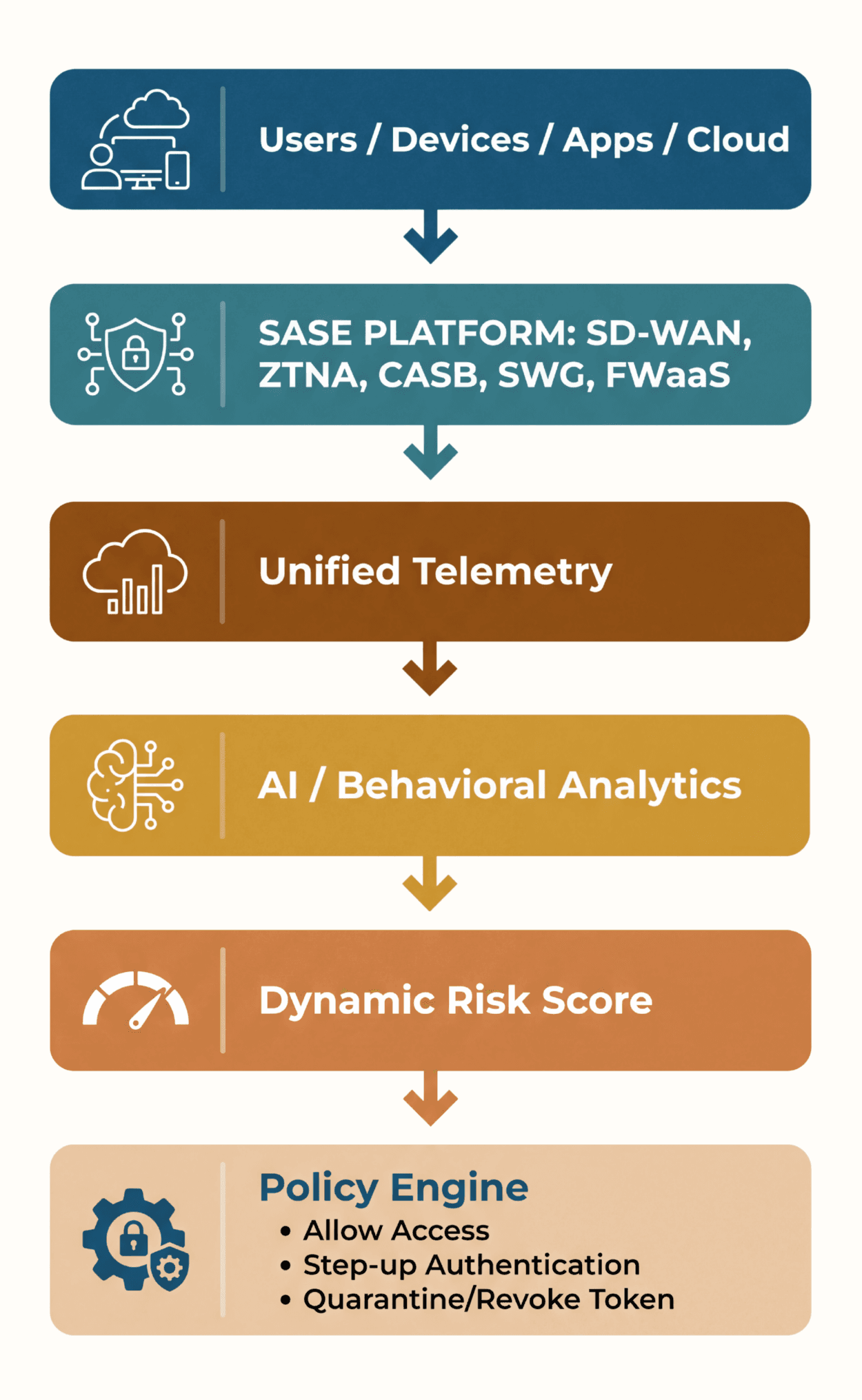
How Artificial Intelligence Transforms SASE Capabilities
It helps to separate three terms that tend to get used almost interchangeably in this space, because they aren’t the same thing. AI, here, is pattern recognition models that learn what “normal” looks like for a given identity, device, or application, and score deviations from it. It doesn’t take any action on its own; it produces an assessment. Automation is the execution layer: pre-defined rules that fire a fixed action whenever a specific, known condition is met, with no judgment involved. Think of a legacy firewall rule that blocks a known-bad IP address every time, regardless of context. Agentic AI sits between the two. It doesn’t just fire a fixed rule, and it isn’t fully autonomous either; it takes the AI model’s read on a situation and selects from a bounded set of pre-approved actions, based on policy a team has defined in advance. AI-driven SASE typically uses all three together: AI to notice, automation to execute the routine cases, and agentic AI to handle the more contextual ones within guardrails a human has already set. Keeping these roles distinct matters when you’re deciding what to trust the platform to do on its own.
Behavioral Analytics and Real-Time Risk Modeling
Traditional access control asks one question: is this user authenticated? AI-driven SASE asks a better one: does this session actually look like this user?
Underneath, this typically runs on User and Entity Behavior Analytics (UEBA) models trained on a rolling baseline of normal activity for each identity, device, and application: usual login times and locations, typical data volumes, and the systems that identity normally touches. Every new session is compared against that baseline and given a dynamic risk score, rather than a simple allow-or-deny decision.
This matters in cases like the Ivanti and Juniper incidents, where attackers didn’t need to force their way in; they used credentials that looked, on paper, entirely legitimate. A signature-based system sees a valid login and stops looking. A behavior-driven risk engine notices when that same login comes from an unfamiliar location at an unusual hour and starts reaching for systems it’s never touched before, and can lower that session’s trust level automatically, before the situation escalates. In effect, it treats a valid credential as a starting point for verification rather than proof of trust on its own.
Trust also isn’t fixed for the length of a session. If risk signals change mid-session, a device fails a security check, or account activity suddenly looks unusual, the system can prompt for extra verification, narrow what that session can access, or end it, without waiting on a human to notice and act.
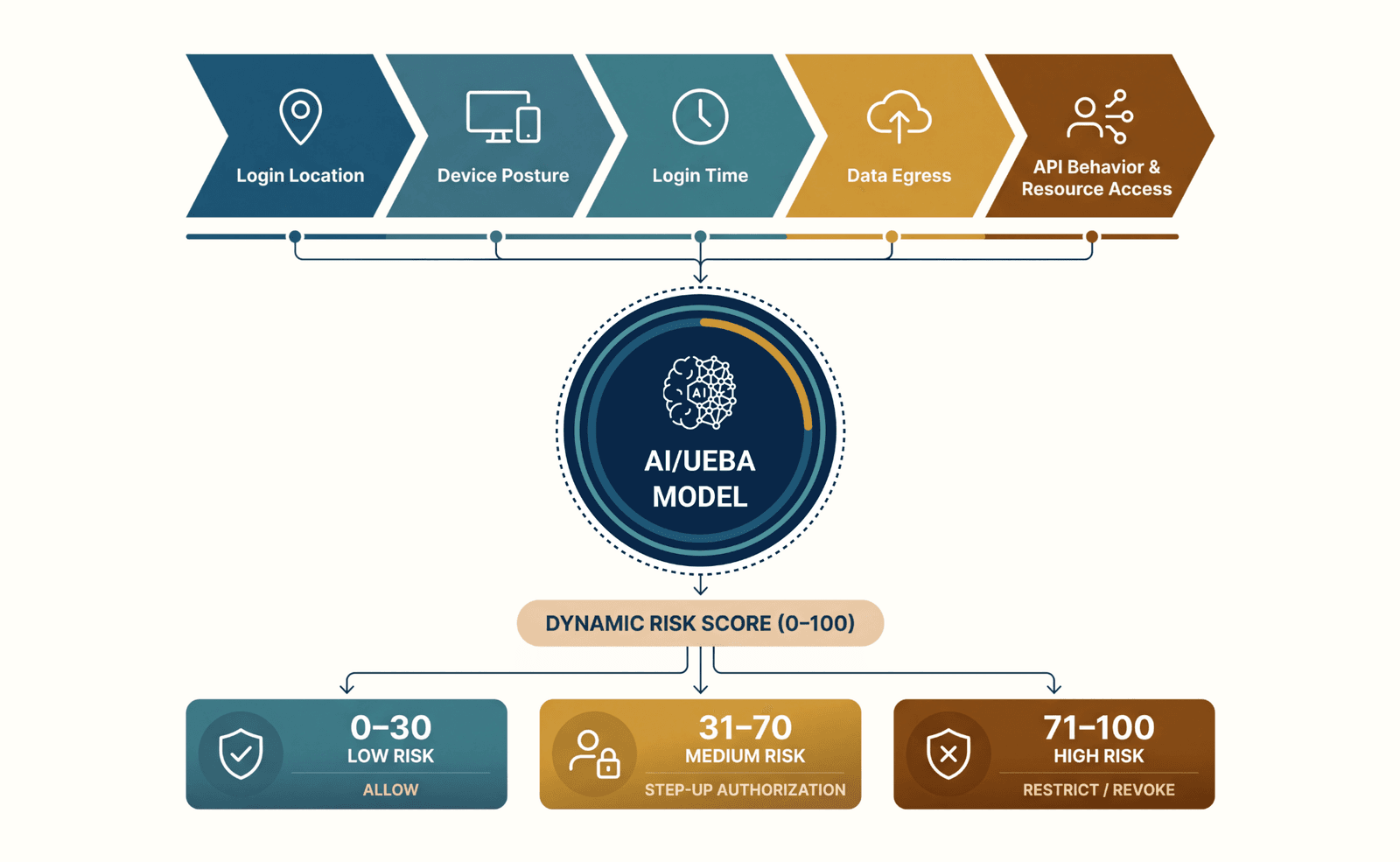
Traditional: Credential Valid → Allow
AI-driven SASE: Credential + Device + Behavior + Context → Trust Score → Continuous Decision
Self-Healing Networks and Agentic AI Actions
This is where agentic AI comes in- specifically, not AI that only watches, but AI that’s allowed to act within defined limits. It plugs into a security orchestration layer that translates a risk score into a bounded, pre-approved action: quarantining a device, revoking a token, rerouting traffic away from a compromised segment, or rolling back a misconfiguration before it spreads.
A simple version of what that looks like as a policy: if a device fails a security check and then tries to reach several unfamiliar internal systems within a short window, quarantine that device, revoke its active session, and alert the on-call analyst with the relevant context attached automatically, without waiting for someone to notice the pattern first.
Given that the average breach in 2025 went undetected for 241 days, compressing that window from months to minutes matters. When a segment of the network starts behaving abnormally, an AI-driven SASE platform can isolate it while keeping the rest of the environment running normally. That containment speed is often the difference between an incident that costs a few engineering hours to clean up and one that ends up in a breach disclosure filing.
As covered above, agentic action works best with clear guardrails. Some actions are usually safe to automate fully, while others should still route through a person for sign-off:
This is the central point of view: agentic action needs guardrails, not blind trust.
- Safe to automate: device quarantine, revoking a standard user’s token, rerouting traffic away from a compromised segment.
- Needs human sign-off: isolating an entire network segment, revoking a privileged account, or touching a production customer-facing system even when the recommendation itself is generated automatically.
Every action, automated or not, should be logged for audit. Done well, this frees NetOps and SecOps from firefighting the same recurring issues and lets them spend more time on the judgment calls that actually need a person.
Integrating AI-Powered SASE Into Your Enterprise Stack
None of these matters if it can’t be operationalized inside the messy, hybrid reality most mid-sized enterprises actually run. Architecture diagrams are clean. Real environments rarely are.
Telemetry Collection Across Hybrid and Multi-Cloud Environments
AI-driven SASE is only as good as the data it can see. If telemetry stops at the data center wall and doesn’t extend into cloud workloads, SaaS applications, and remote endpoints, the result is a smart system with a blind spot, and blind spots are where some of 2025’s worst incidents played out. The Crimson Collective breach, for instance, exposed VPN configurations and infrastructure data sitting in repositories nobody was actively watching for unusual access patterns. That’s as much a visibility gap as it is a breach.
Real integration means pulling consistent signal from across a hybrid environment network logs, cloud provider activity (like AWS CloudTrail or Azure Monitor), identity events, and endpoint data and mapping it into a common format so the tools involved are speaking the same language. Increasingly, that means using an open standard like OCSF (Open Cybersecurity Schema Framework) instead of a custom translator for every source. This normalization work isn’t glamorous, but it matters: an AI model fed incomplete or inconsistent data will produce confident-sounding, wrong conclusions. Skipping this step to get to the AI features faster is a common shortcut and usually the first thing that needs revisiting when the platform’s alerts stop matching reality.
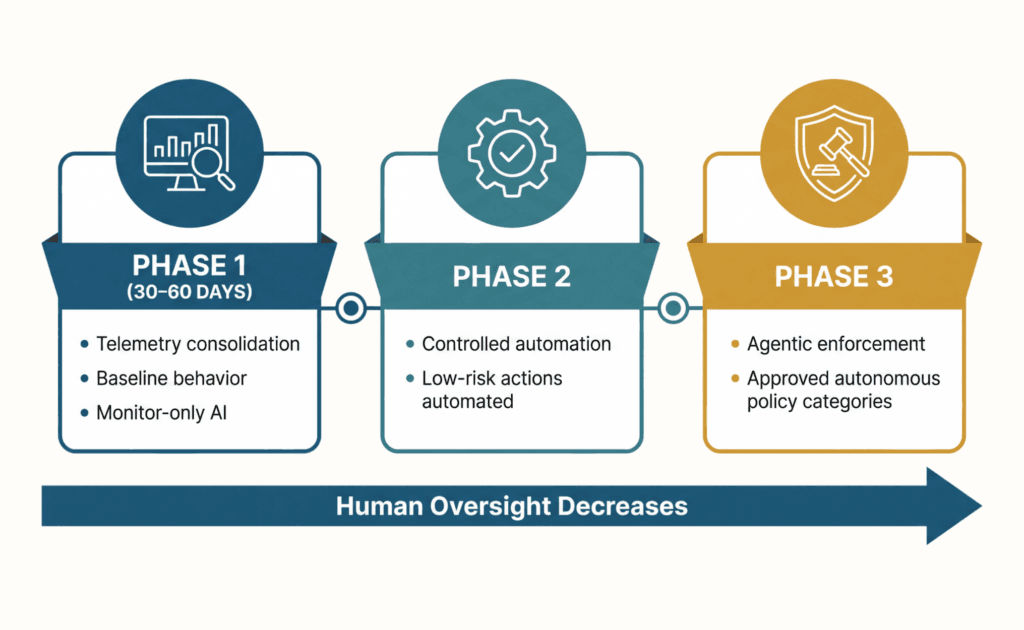
Rather than switching everything on at once, a rollout typically happens in three phases:
| Phase | Duration | What Happens |
| Phase 1: Baseline | 30–60 days | Telemetry is consolidated, and the AI builds a behavioral baseline in monitor-only mode, learning the environment without taking any action. |
| Phase 2: Assisted Response | Ongoing | Automated response is turned on for low-risk, high-confidence actions like device quarantine and step-up authentication. Higher-impact actions still require human approval. |
| Phase 3: Full Enforcement | Ongoing | Agentic enforcement runs across all approved policy categories, with the model reviewed quarterly to catch drift and false positives as the environment evolves. |
Bridging the Gap Between NetOps and SecOps Teams
The biggest barrier to AI-driven SASE success is often organizational, not technical. NetOps is typically optimized for uptime and performance; SecOps is optimized for risk and containment. Historically, the two have worked from separate consoles and separate reporting lines, and that gap can be exactly what attackers exploit, since a performance issue and a security incident can look identical in their early symptoms.
A well-implemented AI-driven SASE platform brings both teams onto shared telemetry through a single control plane, so a NetOps engineer chasing a latency spike and a SecOps analyst chasing a possible compromise are looking at the same event data instead of reconciling two separate dashboards after the fact. Each team still gets a view suited to their job performance metrics: NetOps, risk scores for SecOps built from one consistent dataset.
The way to tell if this convergence is actually working, beyond simply feeling more organized, is to track a few numbers over time: detection and response times trending down, false positives dropping as the baseline matures, and the share of telemetry actively covered by automated policy climbing toward full coverage. None of that happens automatically just because a new platform is in place; it takes deliberate effort from both teams to agree on shared definitions of risk in the first place.
Overcoming Common Implementation Challenges
Managing Platform Lock-in and Architectural Alignment
Many SASE vendors present their platform as the answer to everything. That’s rarely true in practice; what fits one organization’s architecture can be the wrong fit for another. Committing to a single-vendor stack without evaluating fit against existing infrastructure, cloud strategy, and growth plans is often how organizations end up locked into a platform that solves today’s problem while creating tomorrow’s migration project.
Independent evaluation, rather than a single-vendor pitch, tends to serve organizations better here. The more reliable approach is to evaluate AI-driven SASE platforms the way you’d evaluate any major infrastructure decision against your actual environment, not a vendor’s roadmap. That means testing interoperability with your identity provider, existing security tools, and compliance reporting requirements before signing a multi-year contract.
Ensuring Data Privacy and Compliance Governance
The same telemetry that makes AI-driven SASE powerful deep visibility into user behavior, data flows, and application usage also raises real governance questions: Where is that behavioral data stored? Who can access the models trained on it? How would you prove to an auditor that an AI system’s automated access decisions are explainable and compliant with frameworks like HIPAA or PCI-DSS?
Right now, only about half of organizations have an automated incident response playbook for an active data exfiltration event, which suggests these governance questions are often still being answered reactively, in the middle of an incident, rather than worked out in advance.
Governance, risk, and compliance shouldn’t be treated as an annual exercise; it works better as a routine practice built into how the platform is configured and reviewed. Automated decisions need audit trails. Model behavior needs periodic checks for drift or bias. And compliance posture should be something you can demonstrate on demand, not something reconstructed under pressure after an auditor or insurer comes calling. Building this in from the start is considerably less painful than retrofitting it after a platform is already live and handling production traffic.
Final Take
Teams that go through a breach post-mortem rarely say “we didn’t spend enough on security tools.” More often it’s some version of “we had the data; we just didn’t see the pattern in time.” AI-driven SASE is built to close exactly that gap, turning scattered telemetry and reactive alerting into a system that can recognize danger the way a good analyst would, at a speed no human team can match around the clock.
If you’re weighing where to start, a practical first step looks like this:
- Map your current telemetry coverage: where are the blind spots between network, identity, cloud, and endpoint data?
- Identify which response actions are safe to automate today, and which still need a human sign-off.
- Pilot Phase 1 (baseline modeling, monitor-only) on one segment of your environment before committing to a full rollout.
- Set a review cadence quarterly, at minimum, to check the model against real outcomes, not just alert volume.
2025 made the cost of standing still clear: VPN appliances turned into open doors, trusted OAuth tokens became attack vectors, and average dwell times stretched toward a year. None of that means every organization needs to rebuild its entire security stack overnight; most of the value comes from getting the fundamentals right first: full telemetry coverage, a clear line between automated and human-approved actions, and a rollout paced in phases rather than rushed. The organizations doing better going forward tend to be the ones whose infrastructure can think, adapt, and act faster than the threats targeting it, not necessarily the ones spending the most.
Get Your IT Blueprint and see where your infrastructure stands against a modern, AI-driven security architecture mapped to your business, not a vendor’s product line.
Or start smaller: run the free Ransomware Readiness Assessment by Consltek, eight questions on your backups, access, and response plan that will show you, honestly, where your gaps are most likely to cost you.
Need Expert Help?
Schedule a consultation with our team to discuss your specific security needs.
Book a Free Consultation