Could your leadership team name the same five risks?
Ask five people in a growing business to name the company’s biggest technology risks and you may get five different lists.
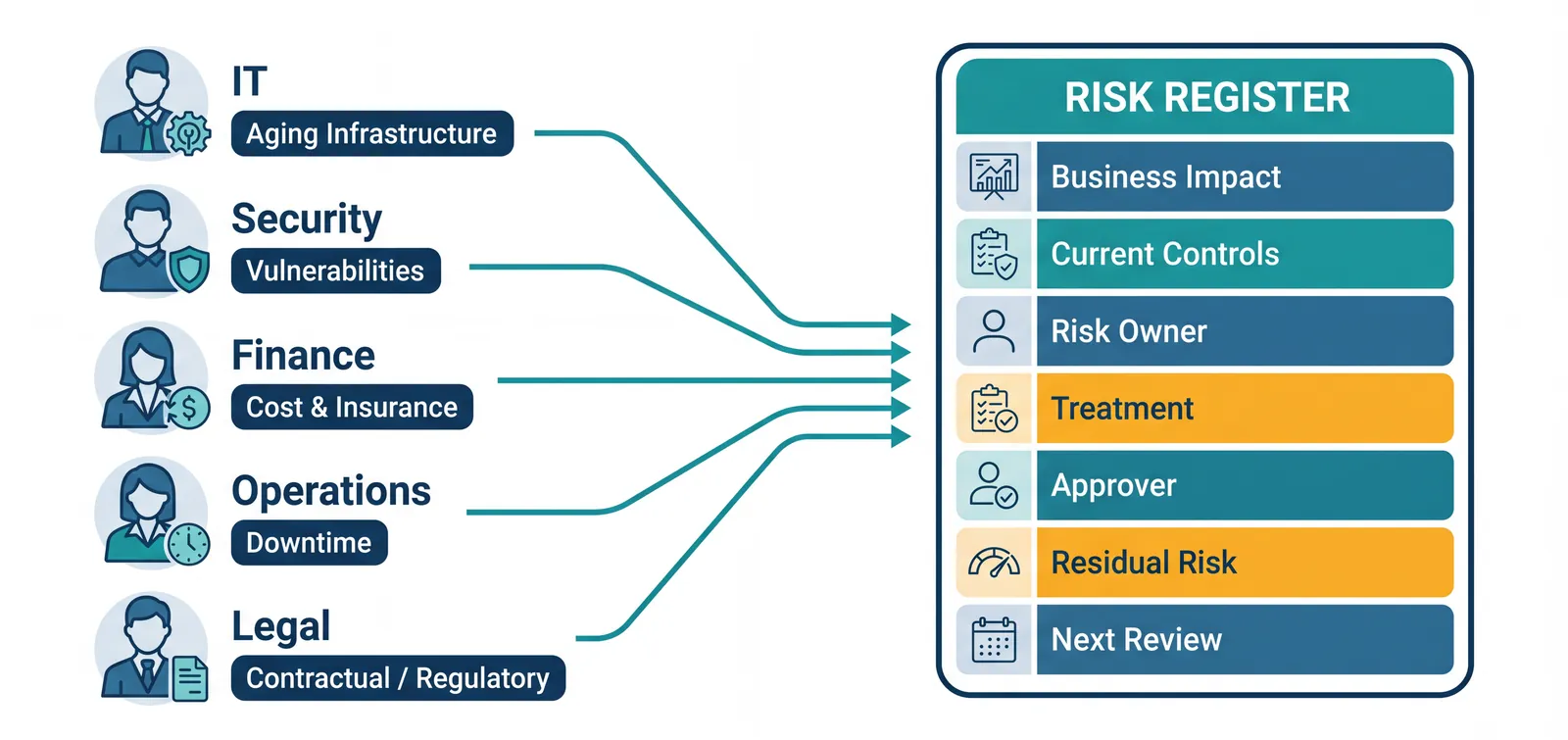
The CIO may be thinking about aging infrastructure, Security about vulnerabilities, Finance about cost and insurance, Operations about downtime, and Legal about contractual or regulatory exposure.
Every concern may be valid. The problem begins when those findings live in separate reports, inboxes, spreadsheets, and conversations, with no shared view of business impact, priority, ownership, or action.
A risk register brings those findings into one decision process. It helps the business move from identifying exposure to prioritizing it, assigning a risk owner, choosing a treatment, approving the decision, and keeping it current as conditions change.
The pressure is rising across the board. In the World Economic Forum’s Global Cybersecurity Outlook 2026, 94% of survey respondents expected AI to be the most significant driver of cybersecurity change, while 87% identified AI-related vulnerabilities as the fastest-growing cyber risk during 2025.
From Technical Finding to Business Priority
A technical finding tells the team something needs attention. It does not automatically tell the business how urgently it should respond, especially when dozens or hundreds of findings are competing for the same people, budget, and maintenance windows.
Consider two vulnerabilities. One is rated critical but exists on an isolated internal test system. The second is rated high, faces the internet, and supports a customer-facing service. In this situation, the internet-facing high-severity finding would normally come first because its exposure and potential business impact create the more immediate priority.
A useful IT risk register adds the context required to reach that conclusion. Existing controls, likelihood, exposure, asset criticality, business impact, ownership, and treatment options all influence the current risk rating.
This is where IT risk management moves a team beyond scanner scores. Our IT Risk Management approach helps connect technology exposure to decisions the business can prioritize, fund, track, and review.
Verizon’s 2026 Data Breach Investigations Report found that 31% of breaches began with vulnerability exploitation. The same report found that only 26% of CISA Known Exploited Vulnerabilities identified in organizations were fully remediated during 2025, while the median time to full remediation increased from 32 to 43 days.
Those findings call for sharper prioritization rather than indiscriminate urgency. When remediation capacity is limited, the useful question becomes which exposure comes first, why it comes first, and who is responsible for moving it forward.
How Consltek Approaches the Risk Register
A register becomes useful when someone can open it and quickly see the decisions that require attention. Our Risk Register service brings identified cybersecurity risks into a structured record that includes existing controls, priority, ownership, treatment, and review.
The approach is grounded in practitioner experience. A Consltek practitioner completes about five full risk assessments each year for Consltek clients and other organizations, bringing direct experience from real environments into how risks are documented and presented.
A useful register should answer five questions clearly:
What could affect the business?
How significant is the exposure after considering current controls?
Who owns moving the risk forward?
What treatment or decision is required?
Who has authority to approve the remaining exposure?
Those questions keep the register connected to decisions instead of allowing it to become another repository of findings.
A Practical Risk Register Example
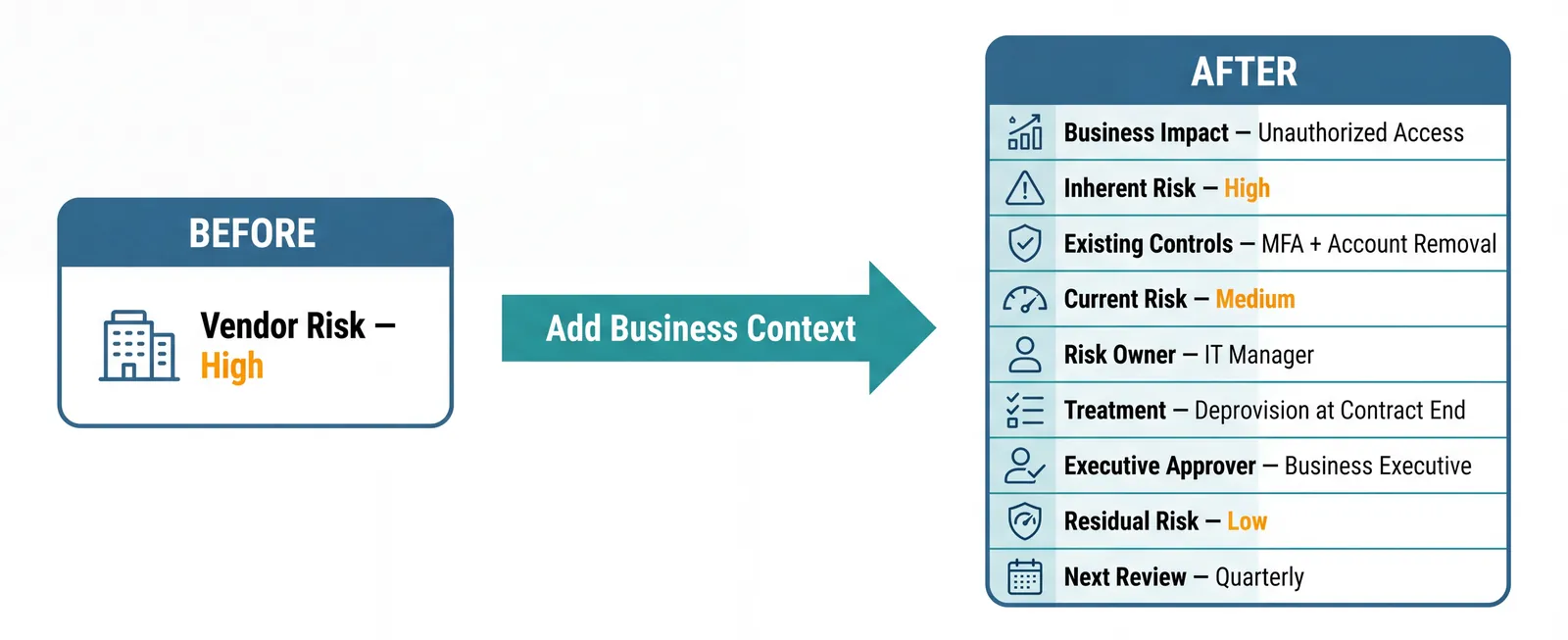
“Vendor risk” may be accurate, but it does not give an IT Manager or executive enough information to make a decision. A stronger entry shows the scenario, potential consequence, existing protection, current rating, accountable owner, treatment plan, and approval path.
Here is a practical risk register example:
Field
Example
Risk
Vendor accounts may remain active after the vendor contract ends
Business impact
Unauthorized access to company or customer information
Inherent risk
High
Existing controls
MFA and manual account removal
Current risk
Medium after considering existing controls
Risk owner
IT Manager
Risk treatment
Trigger deprovisioning when the contract ends and conduct quarterly vendor-access reviews
Target date
October 31, 2026
Residual risk
Low after deprovisioning and scheduled access reviews are operating
Acceptance approver
Executive accountable for the affected business function or data
Next review
Quarterly and after material vendor-access changes
The inherent risk establishes the exposure before existing controls are considered. The current risk reflects controls already operating, while the residual risk shows what is expected to remain after the planned treatment is completed.
The timing of the treatment also changes the quality of the decision. Waiting for a quarterly review to remove a vendor account could leave access active for weeks after the relationship ends, so deprovisioning should be connected directly to contract termination.
Risk Ownership and Approval
A risk can involve several teams without having several owners. IT may administer access, Procurement may manage the vendor agreement, Legal may review contractual obligations, and Operations may depend on the service every day.
One named risk owner should still be accountable for progressing the issue. The owner coordinates the work, keeps deadlines visible, updates the record, and escalates decisions that require authority beyond their role.
Ownership and acceptance authority should remain separate where the potential business impact requires executive approval. An IT Manager may own remediation of a customer-data risk, for example, while the executive accountable for that data or business function decides whether the remaining exposure can be accepted.
That distinction prevents a technical team from carrying a business-risk decision that belongs at a different level of the organization.
What Belongs in the Risk Register?
A cybersecurity risk register should reflect the environment the company operates today. For risk management for growing businesses, that increasingly includes vulnerabilities, external providers, AI, recovery dependencies, identity, cloud services, and changing business processes.
Vulnerability and Infrastructure Risk
Unsupported systems, exposed services, software vulnerabilities, aging infrastructure, and configuration weaknesses belong in the register when they could affect important business operations. The entry should capture the consequence and current controls rather than copying scanner output into another spreadsheet.
The Verizon remediation figures reinforce why context is useful. When only 26% of observed CISA KEVs were fully remediated in 2025 and median full remediation took 43 days, a growing business needs a repeatable way to decide which exposure receives attention first.
Third-Party and Supply Chain Risk
Payroll systems, SaaS platforms, cloud providers, consultants, payment processors, managed services, and other partners can introduce both cybersecurity and operational dependencies. Their access and importance to business operations should be visible alongside internally owned risks.
Verizon’s 2026 DBIR reported that third-party involvement reached 48% of breaches, representing a 60% increase from the prior year. A useful third-party entry therefore captures access, data handled, business dependency, existing controls, internal ownership, and the impact of provider failure.
AI and Shadow AI Risk
AI adoption can change the risk picture within weeks. Employees may introduce meeting assistants, browser tools, coding platforms, AI agents, or external models before traditional inventory and governance processes catch up.
IBM’s 2026 Cost of a Data Breach research found that more than 20% of organizations studied reported a breach targeting AI models or applications. Among organizations reporting an AI-related breach, 92% lacked proper AI access controls.
AI entries may cover sensitive information moving through unapproved tools, personal AI accounts used for company work, excessive agent permissions, poorly governed integrations, or AI models connected to sensitive data without appropriate access controls.
Recovery and Continuity Risk
A successful backup does not show whether the business can restore a critical service within an acceptable timeframe. Recovery risk may include untested restores, unclear recovery priorities, single-vendor dependencies, missing recovery owners, or recovery times that exceed business tolerance.
Verizon’s 2026 DBIR found that ransomware appeared in 48% of breaches in its dataset. That puts recovery readiness directly into the risk conversation, especially when disruption to an essential business service could continue long after the initial security event.
Bringing these categories together gives decision-makers one place to compare very different exposures using a consistent process.
Risk Treatment, Appetite, and Tolerance
Once an exposure has been prioritized, the organization needs a defined response. The treatment choice should record what the business intends to do and what exposure is expected to remain afterward.
Common risk treatment options include:
Mitigate: reduce likelihood or impact through additional controls.
Transfer or share: shift part of the financial exposure through arrangements such as insurance or contractual allocation.
Avoid: discontinue the activity creating the exposure.
Accept: deliberately carry the remaining exposure.
Transfer or sharing does not remove organizational accountability. Insurance may reduce part of the financial impact, for example, while operational, contractual, regulatory, customer, and reputational consequences can remain with the business.
Acceptance also needs a reference point. NIST defines risk appetite broadly as the types and amount of risk an organization is willing to accept while pursuing value, while risk tolerance expresses the level of remaining risk the organization is prepared to bear.
A tolerance could state the maximum acceptable downtime for a customer-facing platform or specify that certain sensitive data types cannot be processed through unapproved AI systems. NIST CSF 2.0 includes establishing, communicating, and maintaining risk appetite and risk tolerance statements under GV.RM-02.
If the residual risk falls within the relevant tolerance, the risk owner can recommend acceptance to the authorized approver. When it exceeds the tolerance, the decision should be escalated so the business can add controls, alter the activity, allocate resources, or formally reconsider the exposure.
The Risk Register Process
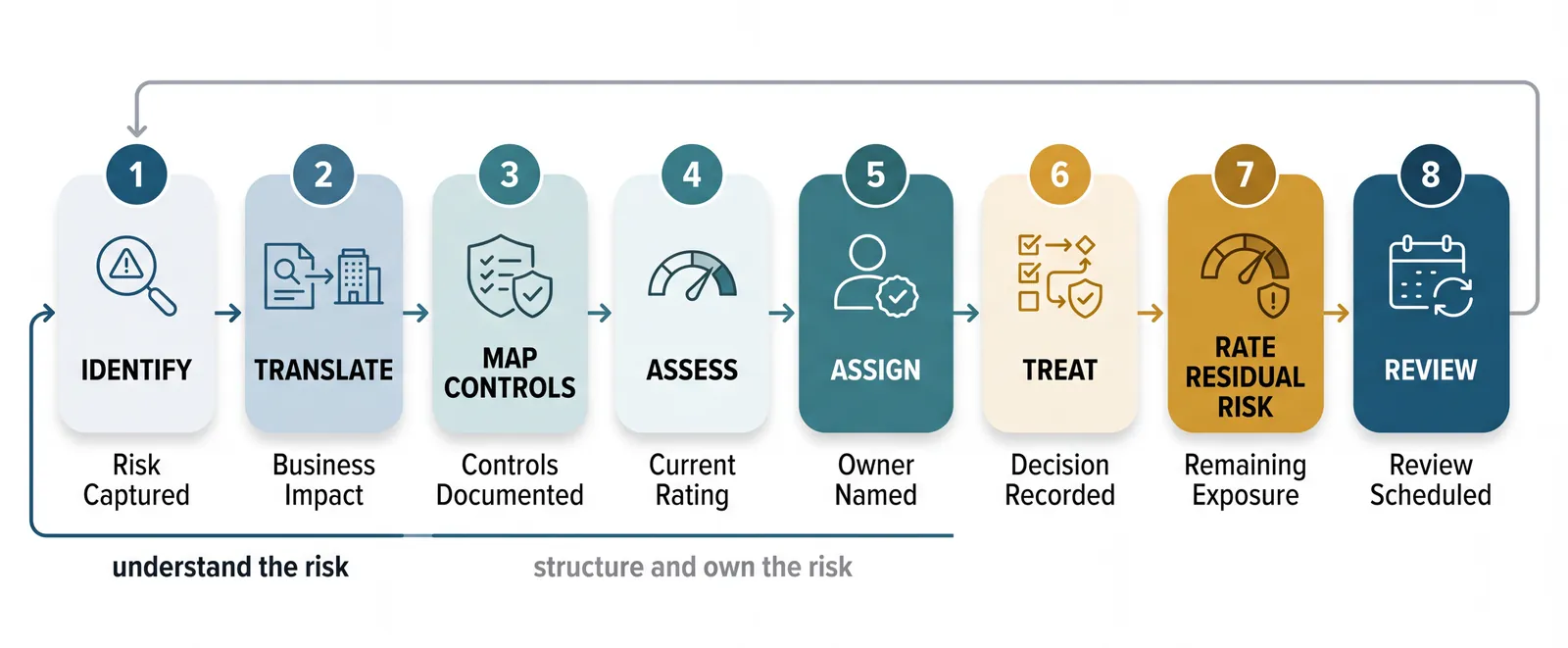
A practical risk register process should preserve enough structure for consistent decisions without becoming difficult to maintain. The order is important because current risk should reflect safeguards that already exist.
1. Identify: Capture meaningful exposure from risk assessments, vulnerability findings, incidents, audits, vendor reviews, projects, and business change.
2. Translate: Describe the potential business consequence so the entry can be evaluated by technical and nontechnical stakeholders.
3. Map Controls: Record the safeguards already operating before assigning the current risk rating.
4. Assess: Rate likelihood and impact after considering those existing controls.
5. Assign: Name one risk owner and identify the approver where treatment or acceptance requires higher authority.
6. Treat: Mitigate, transfer or share, avoid, or accept the exposure using a documented decision.
7. Rate Residual Risk: Rate what remains after the planned treatment rather than assuming every control removes the exposure.
8. Review: Revisit the decision on a defined schedule and when vendors, systems, regulations, business operations, or other relevant conditions change.
NIST IR 8286A Rev. 1 describes cybersecurity risk registers as a way to document risk scenarios, likelihood, impact, appetite, and tolerance so cybersecurity risk can be prioritized and communicated within enterprise risk management.
A Risk Register Template Gives the Team a Starting Structure
A risk register template is useful when it captures the fields required for decisions rather than only a risk name and severity score. A NIST-aligned template can provide a consistent starting structure for teams that currently manage exposure through separate spreadsheets or reports.
Useful fields include the risk scenario, business impact, inherent risk, existing controls, current risk, risk owner, proposed treatment, authorized approver, target date, residual risk, tolerance threshold, review date, and status.
NIST IR 8286 Rev. 1 provides risk register schemas and examples designed to help organizations communicate cybersecurity risk into broader enterprise risk processes.
Where Risk Registers Break Down
A register can be well designed and still lose value if the operating process around it weakens. Four problems appear repeatedly as organizations grow.
First, the register becomes an archive. Risks are added during an assessment, then remain untouched until an audit, customer questionnaire, renewal, or incident puts them back on the agenda.
Second, everything receives the same priority. A long list of “high” risks leaves teams with the same prioritization problem they had before the register existed.
Third, ownership stays vague. Assigning an entry to “IT” or “Security” does not identify the person accountable for progressing the decision, nor does it identify the executive authorized to accept significant residual exposure.
Fourth, the language stays too technical. Executives should be able to see the potential business consequence, current exposure, required decision, and resource need without decoding CVEs or configuration terminology.
A healthy GRC risk register stays current, consistently rated, clearly owned, and usable by the people responsible for business decisions.
Risk Register, Risk Assessment, and Audit Serve Different Jobs
A risk assessment identifies and evaluates exposure, while the register maintains the resulting priorities, ownership, treatment, residual risk, and review status. The two work together, but they answer different questions.
Activity
Primary Role
Risk assessment
Identify and evaluate exposure
Risk register
Maintain priorities, decisions, ownership, treatment, and review
Audit
Evaluate performance against defined requirements
Vulnerability scan
Identify technical weaknesses
Penetration test
Validate exploitable attack paths
Risk review
Reassess decisions as conditions change
A vulnerability scan may discover the technical weakness, an audit may identify a control deficiency, and a risk assessment may evaluate its broader impact. The register carries the decision forward after those activities are complete.
Give Executives a Risk View They Can Use
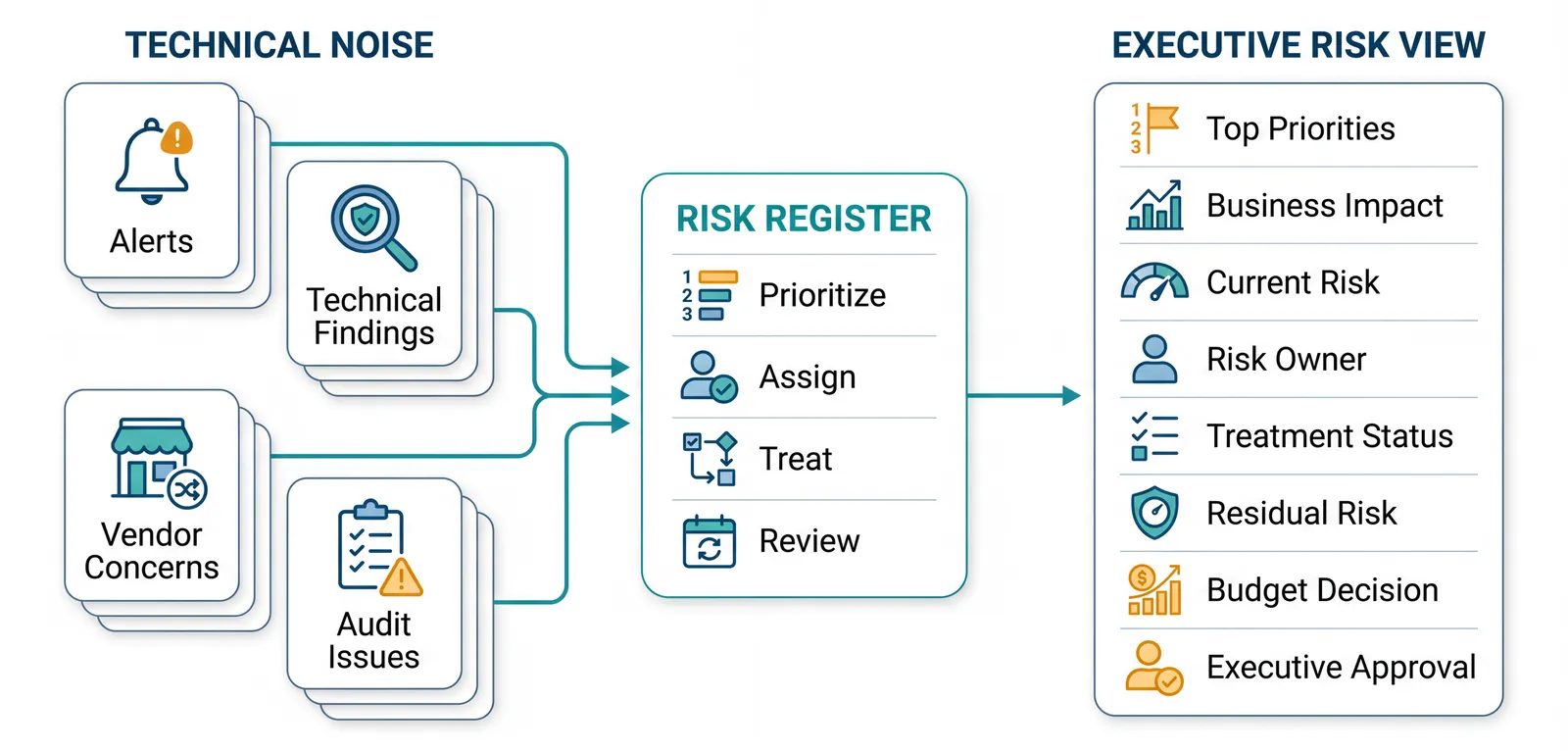
A CIO should not need to present hundreds of technical findings to explain the company’s risk posture. Executives need a shorter, decision-oriented view showing which exposures could materially affect business objectives, what has changed, which treatments are underway, where investment is required, and which decisions need approval.
NIST IR 8286 Rev. 1 focuses specifically on integrating cybersecurity risk information into enterprise risk management. It explains the value of using cybersecurity risk registers and rolling risk information up into a broader enterprise view so cybersecurity can be considered alongside mission and business objectives.
That makes the register useful beyond the security team. It can support discussions with the board, customers, auditors, insurers, investors, and other stakeholders because the organization can demonstrate how important technology risks are being prioritized, owned, treated, and reviewed.
Our broader GRC services help organizations keep risk, controls, policies, ownership, and supporting evidence connected as those requirements evolve.
From Scattered Findings to Governed Decisions
Picture the next executive risk discussion. Instead of arriving with separate vulnerability reports, vendor concerns, audit findings, and spreadsheets, the CIO can show which exposures require attention, which ones already have effective controls, who owns each action, and where an executive decision is required.
That is where a risk register proves its value. Findings become priorities, priorities receive owners, owners move treatment forward, residual exposure goes to the right approver, and important decisions remain visible after the meeting ends.
The company will continue to encounter new technology risk as it grows. A stronger governance process gives the organization a consistent way to decide what it will fix, what it will change, what it will accept, and who has authority to make that choice.
Build a risk register leadership can rely on
If your technology and cybersecurity risks are still spread across assessments, reports, vendor discussions, spreadsheets, and individual memory, Consltek can help bring them into one governed decision process.
Work with Consltek to build a risk register that prioritizes the exposures worth acting on, assigns clear ownership, documents risk treatment and approval, tracks residual risk, and gives executives a defensible view of what needs attention next.
A risk register can provide evidence that risks are being identified, prioritized, assigned, treated, and reviewed. It does not automatically satisfy every audit because requirements vary by standard, customer contract, regulation, and audit scope.
Yes, it can help document material risks, existing controls, remediation plans, ownership, and acceptance decisions. An insurer may still request separate technical evidence, questionnaires, attestations, or specific cybersecurity controls.
A spreadsheet may work while the risk population, owners, controls, and review cycles remain manageable. A GRC platform becomes more useful when multiple teams, frameworks, evidence sets, approvals, dependencies, and reporting requirements become difficult to coordinate manually.
A practical template should include the risk scenario, business impact, inherent risk, existing controls, current risk, risk owner, treatment, approver, target date, residual risk, tolerance threshold, status, and review date.
The risk owner can recommend acceptance, but significant residual risk should be approved by the person with authority over the affected business objective, operation, data, contractual commitment, or financial exposure.
NIST IR 8286 describes cybersecurity risk registers as inputs into broader enterprise risk management. This allows technology exposure to be evaluated alongside other strategic, operational, financial, and business risks rather than remaining isolated inside IT.