What Is SASE Architecture and Why It Matters for US Businesses
Enterprise networks are no longer confined to office walls, data centers, or even national boundaries. Today, employees log in from cafés and airports, applications run across multiple clouds, and sensitive data moves constantly between devices, platforms, and partners.
But here’s the problem: most network architectures were never designed for this reality.
The result is a growing gap between how businesses operate and how their security is built, one that leaves organizations exposed, inefficient, and struggling to keep up.
This is exactly where Secure Access Service Edge, or SASE, comes into the picture. It is not simply another cybersecurity trend. SASE isn’t just another cybersecurity buzzword, rather it represents a fundamental shift in how enterprise architecture is designed and delivered. By integrating its key components, networking and security into an all-in-one, cloud-native solution, it eliminates the friction of legacy systems and provides dynamic, quick, and smart protection. No longer does it just mean securing networks, but it now means being able to allow businesses to move faster, scale smarter, and innovate without fear.
The urgency is more in the case of US businesses. With increasing ransomware threats, ever-increasing regulatory demands, and a distributed workforce, the anxiety of having outdated systems used to be merely inefficient; now, they have become a liability.
It’s no surprise that in 2026, over 65-75% of US organizations are expected to embrace SASE.
The message is clear: security is no longer something you add later; it’s something you build into the very foundation of your business.
Understanding Secure Access Service Edge (SASE)
SASE is fundamentally the convergence of architecture. It combines SD-WAN with smart networking and implements it with the level of advanced security services (like Zero Trust Network Access, Secure Web Gateways, Cloud Access Security Brokers, and Firewall-as-a-Service). These services are provided using a distributed cloud infrastructure, which deploys security policies nearer to users and devices.
What distinguishes SASE in 2026 is the level of intelligence embedded within these platforms.
Leading solutions now incorporate AI-driven threat detection, behavioral analytics, and automated response mechanisms. As a result, SASE security consulting in the USA is evolving beyond a reactive model toward a more predictive approach, hence identifying and addressing potential threats before they escalate into incidents.
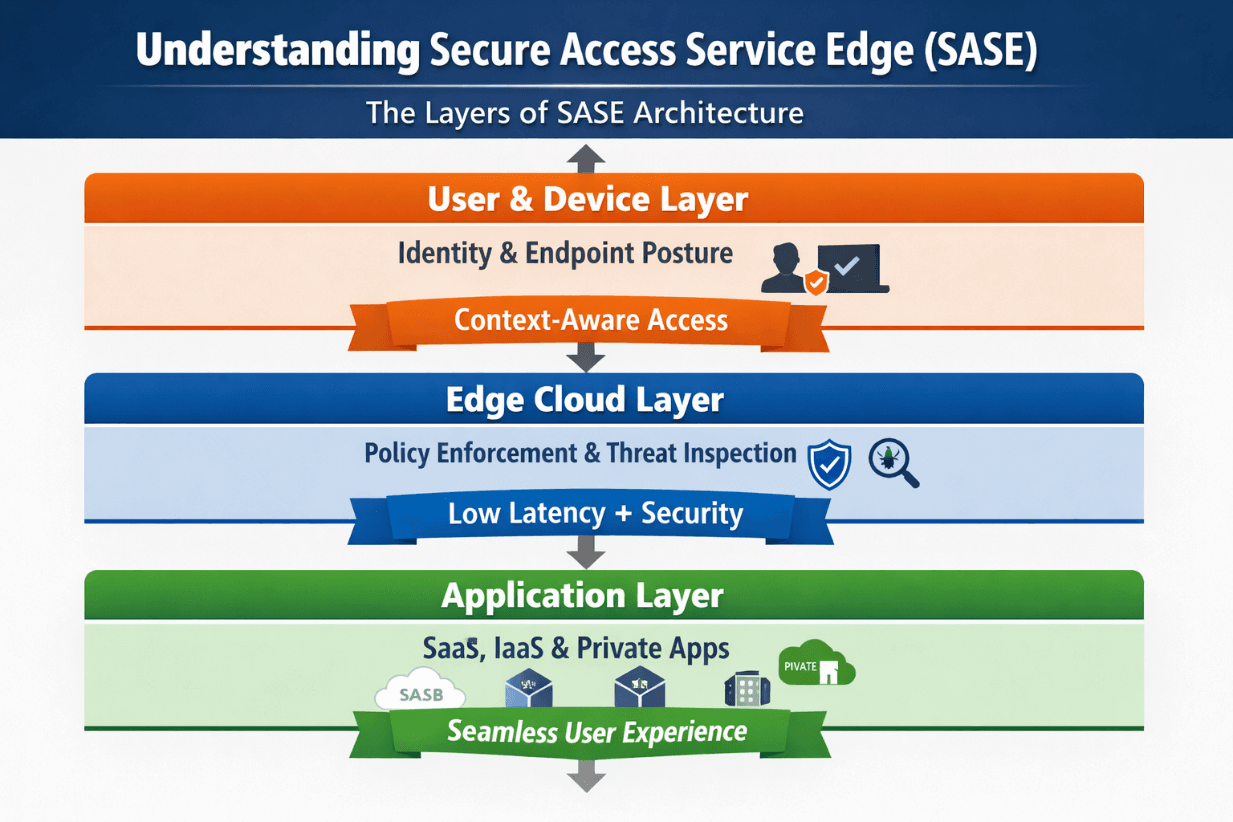
A simple conceptual view of SASE architecture can be imagined as follows:
This layered approach ensures that security is applied consistently, regardless of where users or applications reside.
Why Traditional Network Security Fails in Cloud-First Enterprises
Traditional network security was built for a world that no longer exists! This was a world where workers sat at workstations, applications were stored in data centres, and the edge firewall prevented threats. Going forward today, it is all different. Users are ubiquitous, applications are cloud-based, and threats are omnipresent in all directions. However, still, there are numerous organizations overwhelming contemporary traffic with old VPNs and concentrated gateways that are introducing sluggish performance, annoyed customers, and security vulnerabilities.
This isn’t just inefficient, it’s risky!
Over 70% of recent breaches have exploited these exact weaknesses, especially the over-permissioned access that VPNs provide. SASE turns this model upside down. It does not believe in location but only in identity. It requires your identification, the device that you are using, and whether your actions are safe before granting entry.
The result? A dramatically smaller attack surface, faster access, and a security model built for how businesses actually operate today.
SASE Adoption Trends Among US Enterprises
The rise of SASE adoption isn’t just a trend, but it’s a full-blown shift in how enterprises are securing their future. Across the US, industries like finance, healthcare, and technology are moving fast, recognizing that traditional security simply can’t keep up with modern demands.
Recent industry data highlights several key trends shaping the SASE landscape. What’s driving this momentum is a clear pattern. Organizations are simplifying their stacks by moving to unified SASE platforms while embracing Zero Trust as the new standard for access control.
At the same time, AI is taking secure access service edge consulting to the next level by transforming SASE deployment itself, rather than the consulting function in isolation. Integrating features like real-time threat detection, automated response, and constant performance optimization directly into the SASE framework, AI transforms what used to be only a static security configuration into a self-evolving system with intelligence. Consequently, consulting changes in tandem with this change, shifting to being more proactive in terms of its implementation, where it is more predictive and strategy oriented.
This evolution is transforming SASE from a static architecture into a dynamic, self-improving system.
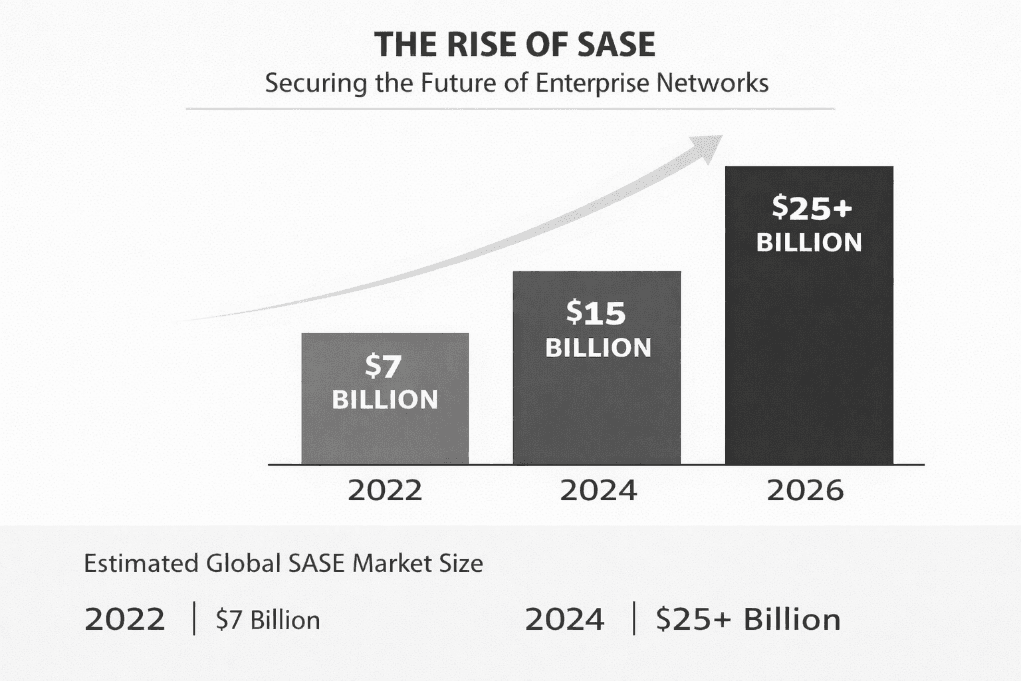
The market itself reflects this growth trajectory:
This rapid expansion underscores the strategic importance of SASE in the modern enterprise landscape.
Our Expert SASE Architecture Consulting Services in the USA
SASE implementation services in the USA are not about technology, but ensuring your network is aligned with your business objectives, compliance, and operations on the ground.
This is where our expert SASE consulting services in the USA advance in simplifying complexities into strategic advantage.
SASE Strategy & Architecture Design
An effective SASE implementation services, USA, journey is initiated by a clear strategy. It will include the evaluation of the existing network and security environment, gaps, and creation of a transformation roadmap. The design phase is used to develop a common architecture to incorporate networking and security, as well as to be scalable and resilient.
It is a process that can be fast-tracked in organizations that employ knowledgeable consulting associates.
At Consltek, we provide the global experience and disciplined procedures that assist businesses in circumventing the typical pitfalls and deliver quicker time frames to value.
Cloud-Native & Hybrid Network Architecture
US businesses are no longer operating in one environment, but across data centres, in-premise clouds, and hyperscale, such as AWS and Azure, simultaneously.
Designing SASE in the light of this reality requires developing a smooth and high-performance architecture with users enjoying rapid and secure access to applications- regardless of their place of residence- but security remains uniform at all levels.
Zero Trust Network Access (ZTNA) Implementation
A SASE replacement of old VPNs with a modern identity-based, identity-driven access model, where ZTNA is part of our consulting services in USA.
At Consltek, we implement secure, application-level access controls that are optimally adapted to your environment - minimizing risk, eliminating lateral movement, and dynamically managing user behavior and the posture of the device.
SD-WAN & Cloud Security Integration
SD-WAN is the core of our SASE architecture consulting services in the USA, which is used to intelligently route traffic depending on real-time network conditions.
Together with cloud-based security, it guarantees the speedy, secure, and reliable connection, making distributed US workforces perform with equal consistency and security at all sites.
Firewall-as-a-Service (FWaaS) & CASB Consulting
FWaaS and CASB solutions extend security to both network and cloud environments. FWaaS provides scalable firewall capabilities without the need for physical appliances, while CASB offers visibility and control over cloud applications.
Together, these services enable organizations to protect sensitive data, enforce compliance policies, and gain insights into user activity across the enterprise.
Managed SASE & Ongoing Optimization
SASE is not a one-time implementation but an ongoing journey. Managed SASE architecture consulting services in the USA, providing continuous monitoring, optimization, and support, ensuring that the architecture evolves alongside the organization’s needs.
This is another area where experienced partners like Consltek add value by providing ongoing expertise and ensuring that organizations stay ahead of emerging threats and technological advancements.
Why Choose a USA-Based SASE Consulting Partner
Choosing a USA-based SASE consulting partner in the present day is not only a matter of location, but it is a matter of keeping up with the fast-paced and risky digital landscape of the world.
Because the United States leads in cloud adoption, SaaS usage, and remote work, it presents both a high-value target for cyberattacks and a landscape that demands security solutions grounded in real-world complexity rather than theoretical models.
The local expertise is where it counts. Consltek, as a SASE solution partner in United States, is familiar with the speed, demand, and regulatory environment of this market, which will help the organization to develop architectures that are not only secure but fast, scalable, and ready for what is next.
Compliance with US Regulations (SOC 2, HIPAA, PCI-DSS)
The complexity of the regulatory environment is one of the best reasons to use a SASE partner based in the USA.
Compliance isn’t a pass-or-fail test with SOC 2, HIPAA, and PCI-DSS, plus the changing legislation of the CCPA and NYDFS; it is a target that is in motion.
As a consulting partners located in the US, we have real-world experience with how these regulations explicitly come together, so your SASE architecture consulting is not just a piece of paper to get by the audits, but one that is designed to withstand scrutiny and audit as required, as well as to evolve with the changing needs.
Low-Latency Architecture for North America
There is an insatiable demand in the US today to find secure and low-latency connectivity due to workforces in various time zones and locations. Employees, customers, data centres, all across the country, performance has ceased to be a luxury, but rather a metric that is vital to business.
A SASE solution partner headquartered in the USA realizes that strategically located edge locations and a well-developed cloud infrastructure can provide access to high-speed, uninterrupted access, thereby, directly increasing productivity, improving customer experience, and promoting revenue growth.
Local Expertise Across Distributed US Workforces
The only thing that stands out in the US is the might of its ecosystem in relation to technology. This is the premises where innovation occurs in real time, home to industry leaders such as Palo Alto Networks, Cisco, Zscaler, and Fortinet, who continue to push the limit of what SASE can achieve.
By partnering with a US-based consulting company, you are not merely staying current; you are ahead and can access new features more intelligently and more quickly, including AI-based threat-centricity and remotely controlled network optimization.
However, it doesn’t just depend on technology, but rather on the talent that lies behind technology. The US is also home to one of the richest networks of cybersecurity and cloud experts, who have experience dealing with complex, large-scale environments. This makes sure that your SASE architecture consulting services are not only being deployed, but that it is being designed more precisely.
By bringing together, local execution (consisting of talent, context, and implementation) in the US market, and global innovation (consisting of technology and innovation) in SASE technologies, organizations can be accelerated in a way to be more creative, and remain robust in an ever-changing and highly dynamic digital environment.
Industries We Serve Across the United States
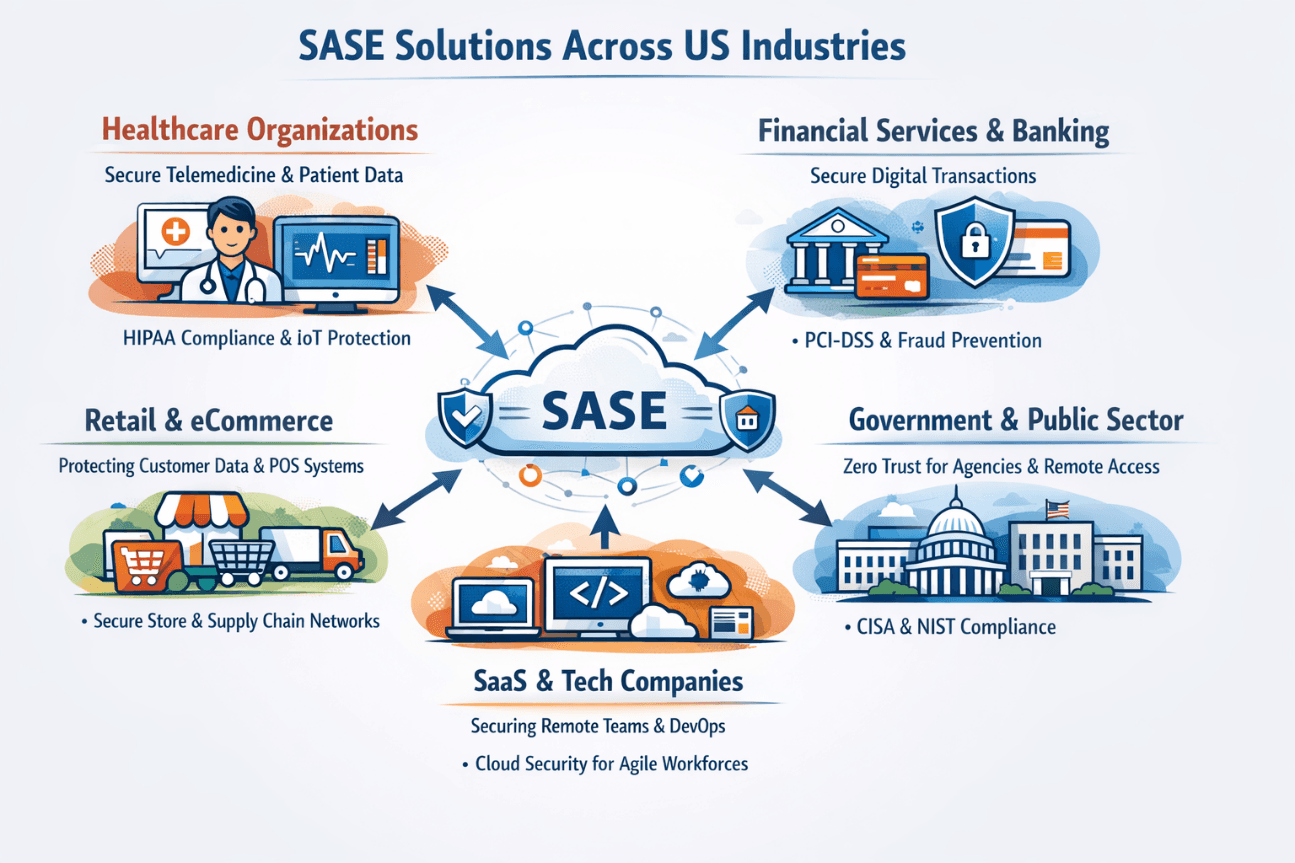
The adoption of SASE into US industries isn’t a hype, but rather it is a pressure that is being put into practice. Whether it is an increasing wave of cyber threats, hard-to-meet compliance requirements, or remote workers, organizations are turning to SASE to address issues that are no longer manageable with older systems. Although industries have their priorities, the general aim is identical: to protect everything, everywhere - without sacrificing performance or user experience.
SASE Consulting for Healthcare Organizations
The US healthcare system is extremely regulated, and security is directly correlated with patient safety. As electronic health records, interconnected workings, and telemedicine continue to rise, the attack surface has greatly expanded.
Clinicians have the ability to access only what they need, and that is on an identity-based platform with access controlled by Zero Trust, secured by SASE, and meeting regulatory standards. Zero Trust Network Access ensures that doctors, nurses, and staff receive only the access they need, determined by identity, role, and device health which is crucial for telemedicine environments operating beyond hospital networks. Leading research from Palo Alto Networks and HIMSS shows that healthcare organizations adopting Zero Trust have significantly improved breach prevention and audit readiness, while Fortinet reports highlight the sharp rise in ransomware targeting hospitals.
One practical illustration of such a change is the case of major hospital networks in the US, which were transitioning away from VPN access to Zero Trust models leveraging SASE. After experiencing numerous phishing and ransomware attacks, one multi-state healthcare organization adopted ZTNA with micro-segmentation of medical equipment. They minimized unauthorized access attempts, increased clinician log-in speeds, and most of all, they guaranteed uninterrupted access to patient records in situations of critical care. Even old medical devices, which were not the most robust, were isolated and secured, and attackers were unable to move laterally within the network.
Financial Services & Banking
The reason why banks are adopting SASE is the necessity to ensure digital transactions and provide seamless customer experiences. Regulated enterprises are upgrading their MPLS networks to SD-WAN combined with cloud security to provide secure, high-performance connections between branches, ATMs, and mobile devices. In the ZTNA, employees can only get the applications they require, minimizing the risks quite a lot.
A real-life situation is based on a large US regional bank that had difficult operational branch connectivity and had an increase in phishing attacks. Once they switched to a SASE model, they replaced VPN access with Zero Trust and incorporated the use of AI-based threat detection. In months, the bank minimized fraud logins, enhanced faster transactions at all branches, and made working remotely secure without affecting compliance. The end result was that suspicious activities (eg, anomalous locations of logging in) were being automatically flagged and blocked on the fly.
Retail, eCommerce & Logistics
Millions of transactions are going on in real time, particularly during high-volume events, such as Black Friday or even festive sales, which means that performance and security are no longer independent of each other: they have to be jointly integrated.
SASE helps retailers build this whole ecosystem and continues to satisfy high performance when scaled. Replacing an old MPLS network with the SD-WAN, combined with the cloud-delivered security, will allow large retail chains to link thousands of store locations, streamline the point-of-sale equipment, and have real-time inventory information available. Meanwhile, such technologies as CASB will allow securing the sensitive customer and payment data and meeting the requirements.
One strong practical example is that of a large US-based retail chain, which implemented a SASE framework pre-nationwide sales event. In the past, they have been affected by delays in checkout lines and exposure to traffic jams. Post the adoption of SASE, they could intelligently route traffic, eliminate downtime during high demand, and automatically block DDoS attacks with the use of cloud-scale security. This outcome was not only the increase in performance, but a faster, easier, and safer shopping experience for millions of customers.
SASE guarantees safety between fleets, warehouses, and tracking platforms, and provides real-time visibility without exposing vulnerable infrastructure.
SaaS, Technology & Remote-First Companies
The adoption of SASE is primarily dominated by technology and SaaS companies since their activities are distributed and cloud-based on a global scale. They do not depend on VPNs but use ZTNA to provide developers with access on an application level- a secure access that minimizes risks such as credential theft and horizontal movement. In remote-first teams, SASE provides a location-independent access control based on identity and context to allow flexibility and control.
A case in point is a fast-developing American SaaS corporation that experienced issues with access to developers in various cloud systems. Following their adoption of SASE using ZTNA, they have done away with VPNs, secured access to production systems, and incorporated security into their DevSecOps pipeline. The outcome was quicker deployments, a reduction in security breaches, and the smooth cooperation among teams around the world.
This is where SASE proves to be indeed magical to tech companies, innovation with security.
Government & Public Sector (USA)
US government agencies are extremely pressured to strike a balance between hard compliance, the old system, and the rising demand for secure remote access. Attempts such as the Federal Zero Trust Strategy and recommendations by both CISA and NIST are rapidly turning SASE into the foundation of modern public-sector security.
One such application would be to have employees and contractors be able to access securely with ZTNA, so that users only access authorized systems. SASE also introduces centralized visibility, which assists agencies in observing sensitive data streams and identifying threats in real-time across teams.
An actual case would be a state government agency that had to modernize its remote workforce when expanding digital services. With SASE, they substituted a VPN-based access with a Zero Trust and secured data belonging to citizens across their departments, and enhanced the performance of the system among remote workers.
That is the transformation of government SASE creates: making it more secure, allowing government services to be digital, and generating trust on a large scale.
The US Department of Defense and other federal agencies have also explored SASE-like architectures to modernize their networks and improve resilience against cyber threats. According to CISA’s Zero Trust Maturity Model, the shift toward identity-centric security is a cornerstone of future government cybersecurity strategies.
SASE Consulting Coverage Across the USA (GEO-O Section)
In the USA, the demand for SASE consulting varies by region, which is due to industry requirements, regulations, and the maturity of the clouds. In the New York financial acumen and California tech-driven or Texas enterprise-plagued regions, every area approaches SASE in a varying way.
Local experience and world knowledge to provide high-impact, customized SASE solutions.
SASE Architecture Consulting Services in New York
New York is among the most high-stakes SASE markets in the US, with the motivation of finance, media, and rigorous regulations such as NYDFS, PCI-DSS, and SOC 2. Banks are quickly replacing VPNs with Zero Trust in SASE, which can minimize the risk of breaches and ensure real-time trading and digital banking.
At such a dense, user, and critical application scale, latency does count, and low-latency, edge-based SASE architectures are critical.
According to Gartner’s Zero Trust adoption reports, financial institutions in regions like New York are among the fastest adopters of identity-based access models.
Consltek support such environments by designing architectures that balance performance, compliance, and security, ensuring that enterprises remain competitive while meeting regulatory expectations.
SASE Consulting in California (San Francisco, Los Angeles)
California, particularly San Francisco and Los Angeles, represents the innovation epicentre of SASE adoption. Unlike New York, where compliance is the primary driver, California’s adoption is fuelled by cloud-native operations, SaaS ecosystems, and rapid innovation cycles.
One of the real-world applications includes having SaaS companies allow secure access through multi-clouds to developers with the ZTNA rather than VPNs. This helps to assure the developers that they can access particular workloads without bringing the wider network to light. Reports by Zscaler and Palo Alto Networks have suggested that these implementations have caused a major reduction in security incidents subject to credential compromise.
Since Los Angeles has a high density in the domain of media, entertainment, and logistics, the case is somewhat different. In this case, SASE enables the distribution of large amounts of content and safeguards intellectual property. Cloud-delivered architectures are especially useful due to their high bandwidth and low latency requirements.
Global consulting firms such as Consltek play a key role in these environments by helping organizations move beyond fragmented deployments and adopt fully integrated, future-ready SASE architectures that align with rapid innovation cycles.
SASE Consultants in Texas (Austin, Dallas)
Unlike New York or California, where the focus is either compliance or innovation, Texas represents a balanced market where cost optimization, scalability, and performance are equally important. Organizations here are often transitioning from legacy infrastructure, including MPLS networks and on-premises data centres, to more flexible and cost-effective architectures.
The typical real-life application in the state of Texas concerns businesses moving away to SD-WAN deployed on a SASE architecture instead of MPLS. This change lowers the costs of operation and enhances the performance of the networks in separate locations. Reports by Cisco on the adoption of SD-WAN and SASE show that companies in some areas, such as Texas, have realized substantial cost savings and improved their security posture.
Austin and Dallas, with their density of large companies and data centres, are geared towards updating the legacy infrastructure without disruption to the operations. This usually comes with a gradual SASE deployment aided by seasoned consulting partners.
Nationwide Remote SASE Consulting Services
Geography has become a non-issue, especially with the growth of remote work. No longer is a company in New York, Texas, or a smaller city in the US confined by its location to hire the best SASE expertise in the world.
What was once exclusive to large enterprises is now accessible to mid-sized organizations, empowering them to grow securely and confidently.
This is even stronger with continuous optimization. SASE does not stand still; it is dynamic. The remote monitoring and real-time analytics allow architectures to be constantly updated as threats emerge and businesses evolve.
SASE Architecture vs Traditional Network Security
SASE is not a simple upgrade, but a total architectural change.
The old paradigms of centrally-built models with data centres, MPLS, and firewalls operated in a fixed, perimeter-based world, but it does not exist anymore.
The modern business world is spread across the cloud, remote workers, and multiple environments, and traditional systems are not adequate.
SASE reinvents this by integrating networking and security into one scalable, intelligent, cloud-delivered platform created to meet the needs of modern business.
SASE vs VPN and MPLS
VPNs and MPLS were the technologies that formerly served to support enterprise connectivity, but these were constructed to connect a centralized world that no longer exists.
Sending traffic across data centers (backhauling) is performance-limiting, and MPLS is expensive with a lack of scalability.
SASE is different since it allows direct-to-cloud access via edge locations, which has minimized latency and enhanced user experience. Users receive application access with the help of ZTNA rather than network access, which enhances security.
With real-world deployments, organizations report 40-60% improved performance and cost savings, making SASE an obvious option for modern US distributed enterprises.
SASE vs Legacy Firewalls
The migration to cloud, SaaS, and remote work has radically altered the way businesses are running and how they need to protect their environments. The old firewalls were built when the user and application were confined within a specific network perimeter. The model is no longer valid today. SASE is a new solution designed around distributed, cloud-driven environments. The following table shows the differences between these two approaches when it comes to tackling the challenges of current security and performance issues.
Aspect
Legacy Firewalls
SASE (Firewall-as-a-Service)
Security Model
Perimeter-based, limited to defined network boundaries
Cloud-native, enforced at the edge closer to users and apps
Architecture
Multiple firewalls across locations → complexity
Unified, centrally managed security framework
Policy Enforcement
Inconsistent across environments
Consistent, global policy enforcement
Integration
Works in isolation
Integrated with CASB, SWG, and ZTNA
Threat Detection
Static, rule-based, signature-driven
Dynamic, AI-driven analytics with real-time response
Migration financial and operational costs: The cost to shift to SASE is high in both financial and operational terms. Although the first transition needs some strategic considerations, the long-term gains in cost effectiveness and optimization of performance are great.
The comparison below covers differences between SASE and traditional architectures in terms of the important metrics in the enterprise:
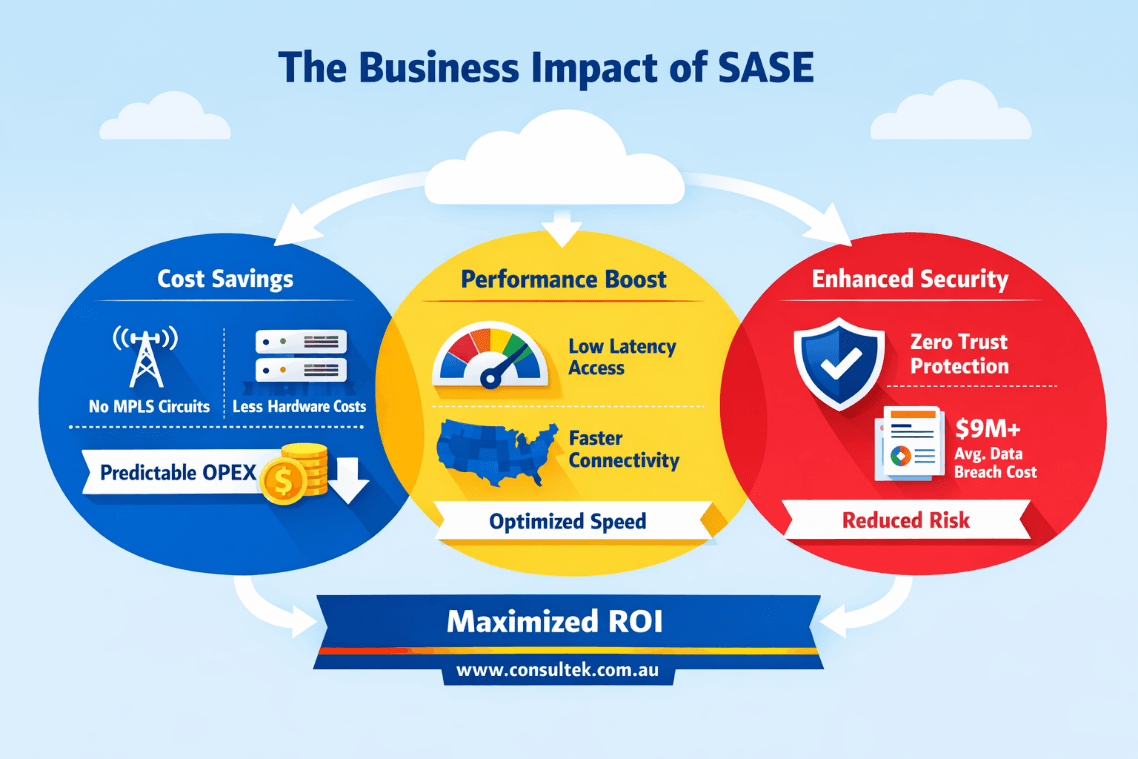
Another critical factor is the cost of security incidents. According to IBM’s 2025 Cost of a Data Breach Report, the average cost of a breach in the United States is $10.22 million. By adopting SASE and implementing Zero Trust principles, organizations can reduce the likelihood and impact of such incidents, delivering both direct and indirect cost savings.
The following diagram presents the way SASE provides business value in three important aspects. On the left, there are cost savings through cutting MPLS and lessening hardware costs. The high performance is enhanced by the low-latency, optimized connectivity in the centre. Zero Trust allows tightening security on the right and decreases the risk of breach. All these pillars propel high ROI, which makes SASE a well-endowed, future-thinking solution to modern businesses.
By designing optimized architectures and ensuring smooth transitions, they help enterprises maximize return on investment while minimizing disruption.
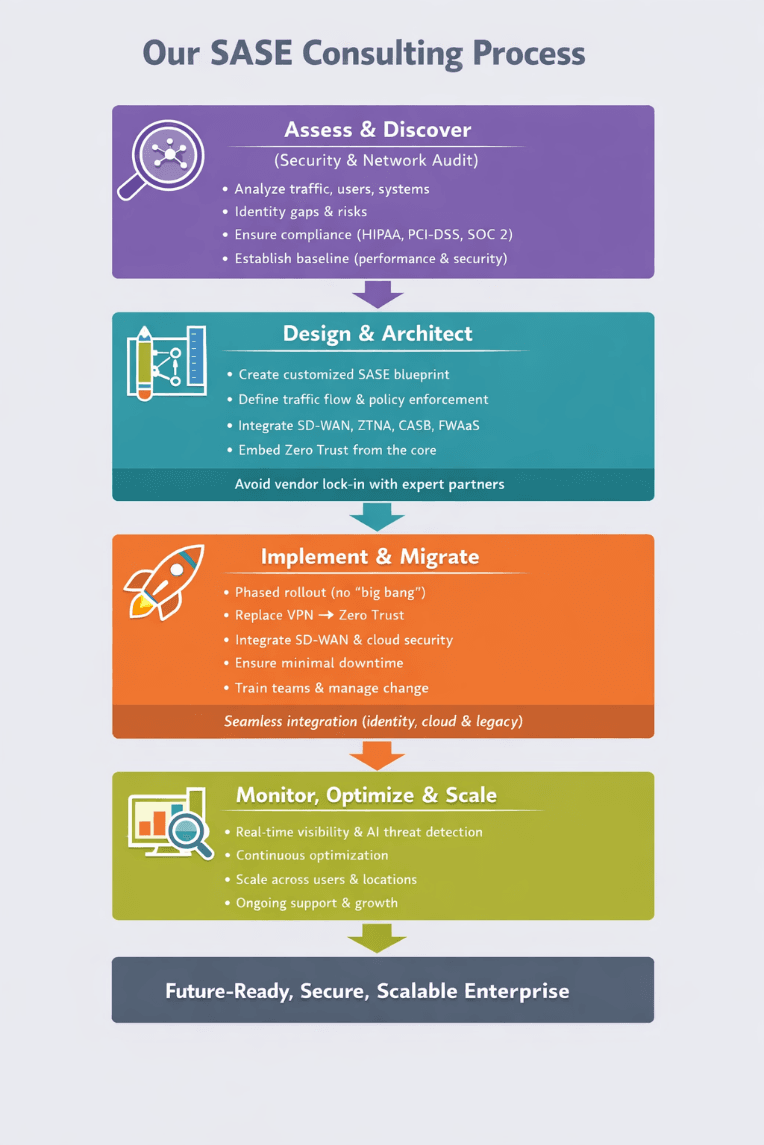
Our SASE Consulting Process
A successful SASE transformation isn’t about tools; it’s about getting the process right. In today’s high-stakes US environment, where compliance, performance, and security collide, how you implement SASE matters more than ever.
The real difference? Winning organizations don’t just adopt SASE; they execute it strategically. While rushed deployments create chaos, a well-orchestrated approach builds a future-ready architecture that scales, adapts, and performs.
That’s where Consltek stands out, bringing a dynamic, lifecycle-driven approach that evolves with your business, minimizes disruption, and turns SASE into a true competitive advantage.
Assess & Discover (Security & Network Audit)
The real power of a SASE transformation begins with clarity. This phase uncovers what’s really happening inside your network, often revealing a tangled mix of legacy systems, cloud apps, and hidden security gaps that have built up over time.
Through a deep assessment, every traffic flow, user behavior, and system dependency is analyzed to expose inefficiencies and risks before they become problems. In the US, this step is even more critical, ensuring alignment with strict regulations like HIPAA, PCI-DSS, and SOC 2.
The biggest eye-opener? Many organizations discover overexposed VPN access, one of the fastest ways attackers move inside networks. Fixing this early with Zero Trust changes everything.
By the end, you don’t just get insights, you get a clear baseline to measure real performance, security improvements, and ROI.
Design & Architect
Here, the change really takes place; here, the profound analysis becomes tactical innovation. After the existing environment is well known, the angle of design of a SASE architecture comes into focus, where the requirements closely match the business objectives and vision of the organization.
This is not the best way to select one vendor or to use one template. It is concerned with developing a more specific plan that integrates networking and security and responds to actual business requirements. This would imply striking a right balance in the US between low-latency performance to the distributed users, high compliance standards, and portability between legacy and modern SaaS applications.
It is at this point that the architectural choices that are critical will be made, such as the flow of traffic, the locations of policy enforcement, and the integration of identity and access control. Such components as SD-WAN, ZTNA, CASB, and FWaaS are intended to be operated within one and the same control plane.
The power of modern SASE design is the Zero Trust approach that is implemented at the ground level. Rather than adding security on top, it is inherent in all interactions via identity, context, and ongoing authentication.
Organizations like Consltek access established frameworks and vendor-neutral experience - organizations can avoid over-engineering and vendor lock-in, avoid integration gaps, and create an architecture that is scalable and vendor-neutral.
Implement & Migrate
It is the place where it all comes to life, when your SASE architecture starts moving beyond design, to an actual impact. The implementation process is usually the most difficult, as it involves the transition out of legacy systems without interrupting the usual business processes.
But this isn’t a risky “big bang” change. Intelligent organizations follow a stepwise strategy, with an initial cluster of use cases such as remote access or branch connectivity. This enables them to perform tests and refinements and gain confidence, and then expand throughout the enterprise.
Change itself is a compelling force, to swap VPNs with Zero Trust, better connectivity with SD-WAN, and move security into the cloud. Each of the steps is well planned to make sure that it is compatible with the existing systems and has minimal downtime.
Meanwhile, people are the basis of success, not technology. Teams have to adjust to new workflows, tools, and policies, and communication and training are essential to seamless adoption.
It happens behind the scenes, whereby a seamless integration is essential to tie identity providers, cloud engines, and legacy applications together into a single system.
This is why companies are seeking the services of trusted partners such as Consltek, who introduce institutionalized migration plans and practical skills to guarantee a risk-free, effective, and efficient move.
Monitor, Optimize & Scale
The journey does not end with implementation. In fact, this is where the true value of SASE begins to emerge. Unlike traditional architectures, which are often static, SASE is designed to evolve continuously.
Monitoring is where SASE delivers continuous value, providing real-time visibility into performance, user activity, and security events. With AI-driven analytics, organizations can detect threats faster, automate responses, and stay ahead of evolving cyber risks in the US market.
Optimization fine-tunes policies, improves routing, and enhances user experience, while scaling ensures the architecture grows seamlessly with new users and applications. With ongoing support from partners like Consltek, businesses keep their SASE environment agile, secure, and future-ready.
Conclusion
SASE is no longer the future; it’s the foundation of modern enterprise security in the USA. As businesses move to cloud-first, distributed environments, legacy models simply can’t keep up, making unified, intelligent architectures a necessity.
Across industries and regions, success depends on how SASE is implemented—from strategy to continuous optimization. Partnering with Consltek, can turn complexities of organizations into clarity and build secure, scalable, future-ready networks with confidence.
Get Started with Expert SASE Architecture Consulting in the USA
The shift to SASE is no longer optional for organizations aiming to stay secure, scalable, and competitive in a cloud-first world. Whether you are modernizing legacy infrastructure, enabling a remote workforce, or strengthening your Zero Trust posture, the right consulting approach makes all the difference.
With expert guidance from Consltek, organizations can accelerate their SASE journey, reduce risks, and build a future-ready architecture aligned with the business goals.
Ready to evaluate your network for a modern, secure transformation? Schedule a Free SASE Architecture Assessment today: book a SASE architecture assessment.
SASE consulting costs vary from $50-$200+ per user/month, depending on complexity and scale. Most organizations see long-term savings through reduced hardware, MPLS, and operational costs. Consltek’s services can guide organizations to optimize spending with right-sized, scalable solutions.
Implementation can take as little as 4-6 weeks and go up to several years for focused use cases and several months for full enterprise transformation. Most companies adopt a phased approach to ensure minimal disruption and faster value realization.
Yes, SASE is highly suitable for SMBs due to its cloud-based, subscription model and scalability. It provides enterprise-grade security without heavy infrastructure investment.
Leading SASE vendors include Palo Alto Networks, Zscaler, Cisco, and Fortinet, each offering unique strengths. The right choice depends on your infrastructure, goals, and security needs. Consltek provides vendor-agnostic guidance to select the best-fit solution.