Dana runs operations at a 200-person manufacturing company. She has one rule for Saturdays: no work. Just pancakes, her daughter's soccer game, and a phone face-down on the kitchen counter.
That plan lasted until the first IT call.
The order system was unavailable. Three large clients were trying to place orders. Her operations lead needed a quick decision, one vendor said the network looked fine, another wanted the application team involved, and nobody seemed to own the whole problem.
The "quick call" became most of the morning.
At some point between chasing updates and trying to work out which vendor was responsible, Dana asked herself a question many leaders at growing companies eventually ask:
How did running the business turn into managing IT problems?
The answer usually has less to do with one failed system than with the way the IT environment has grown.
A company adds people, locations, software, cloud services, security controls, vendors, and customer requirements over several years. Each addition may be reasonable. The problem appears when nobody updates the operating model around them.
That is where operational IT management becomes important.
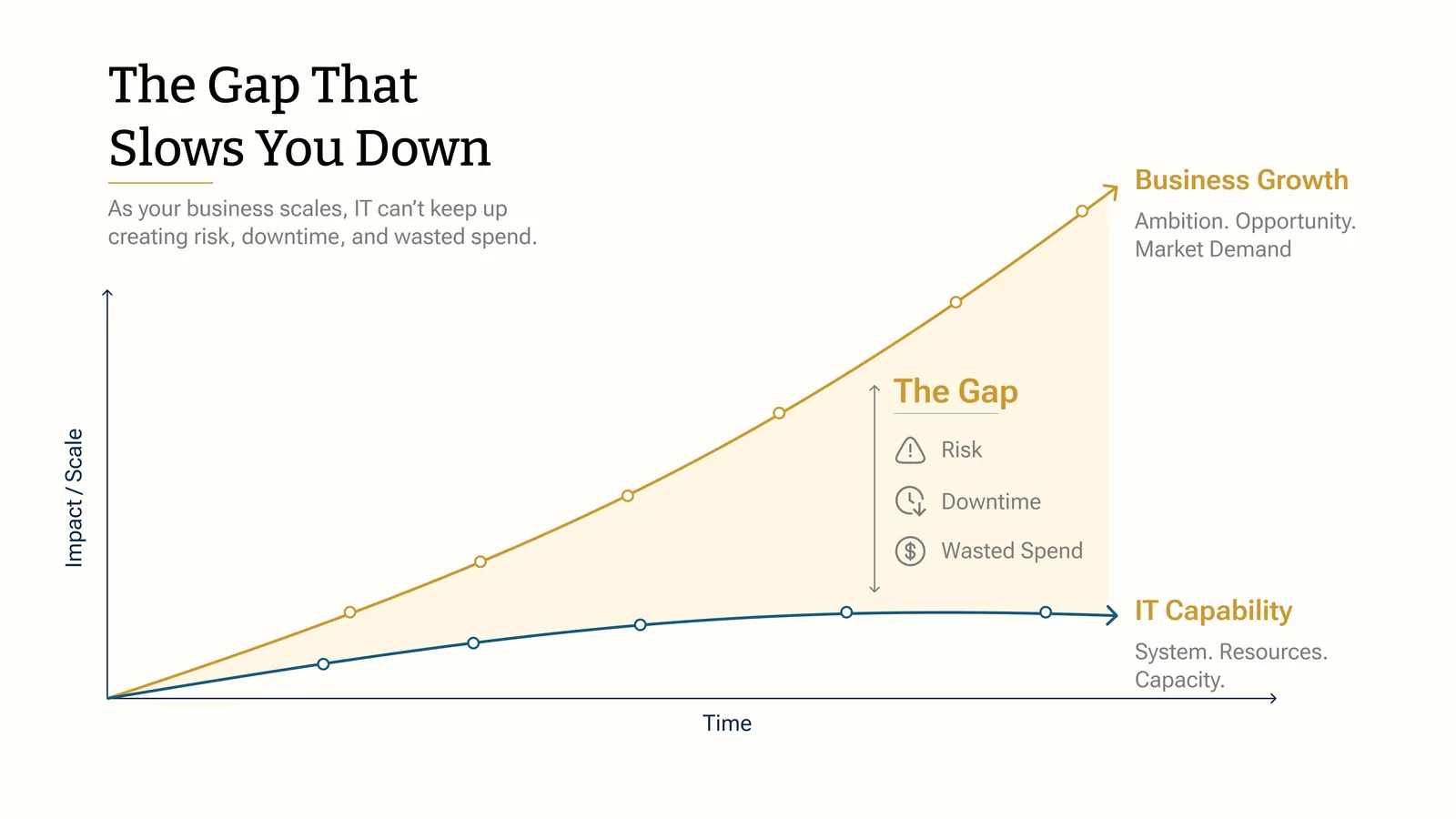
Your business grows faster than your IT can keep up. The gap between the two is where chaos, wasted money, and missed opportunity quietly gather. This guide shows how it forms, what it costs, and how to close it.
When Did Your Operational IT Management Start Falling Behind?
Ask a leadership team what is wrong with IT and you will usually hear symptoms.
The Wi-Fi is unreliable.
The support provider takes too long.
Software spending keeps increasing.
A system breaks every few weeks.
Security questionnaires take days to complete.
Those complaints are useful, but they do not explain how the company arrived there.
In many growing businesses, IT develops through hundreds of small decisions.
A sales team adopts a new SaaS tool because it needs something immediately. Finance renews a contract because replacing it would take too much time this quarter. A second location copies the setup from the first. A new security product gets added after a customer asks a difficult question. Access permissions remain because nobody wants to remove something an employee might still need.
None of those choices necessarily looked unreasonable when they were made.
After a few years, however, the company may have an IT environment that nobody deliberately designed.
The network team knows the network. Finance knows the invoices. Department heads know the applications they use. Vendors know the products they support. One long-serving employee may know why a strange configuration still exists.
Leadership rarely has all of those answers in one place.
That gap becomes more noticeable as the company grows.
A setup that worked for 20 employees can become difficult at 100. At 200, undocumented dependencies and unclear ownership can affect productivity, customer service, security, and the ability to make investment decisions.
The first step in better operational IT management is recognising that the business has changed enough to need a different operating model.
What Is Reactive IT Management Really Costing Your Business?
Reactive IT can look cheaper because its costs arrive in small pieces.
A twenty-minute delay here. Another software renewal there. A manager pulled into a vendor call. A recurring issue fixed again without anyone investigating why it keeps happening.
Individually, these events may not look serious.
Together, they consume time and budget that could have gone elsewhere.
Typical costs include:
Employees losing productive time to unreliable systems or slow devices
Licences remaining active after people leave or change roles
Departments buying products with overlapping functions
Cloud resources continuing to run after projects finish
Senior staff spending hours coordinating vendors
Security weaknesses staying open because ownership is unclear
Projects slowing because the existing environment cannot support them cleanly
There is also a practical question worth asking before buying another technology product:
Are you already paying for something that solves the same problem?
In one engagement with Cleveland University Kansas City, Consltek identified opportunities to simplify the organisation’s security environment. The IT Blueprint gave the organisation greater visibility into its security environment and identified $200,000 in redundant security tools. The client later credited Consltek’s personalised approach with delivering significant IT cost savings.
Sometimes the next IT investment is necessary. Sometimes the better decision is to understand what the company already owns.
Why Hasn't Your Existing IT Provider Fixed the Operational Problem?
Many growing companies already have an MSP, software vendors, cloud providers, and an internal IT person or small team.
So why does leadership still get dragged into IT problems?
Often, responsibility is divided too narrowly.
The internet provider handles connectivity.
The firewall company handles the firewall.
A SaaS vendor supports its application.
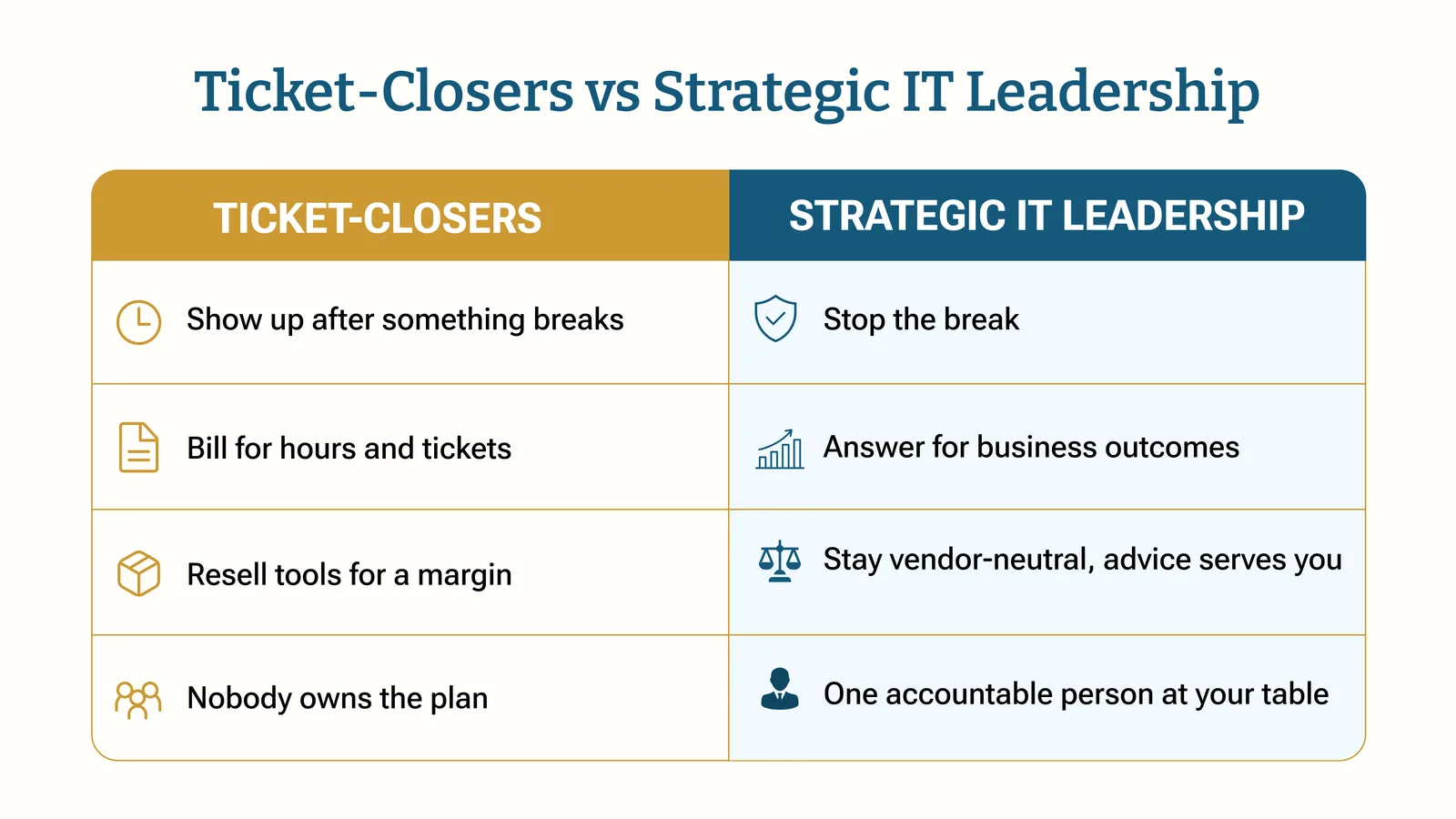
An MSP works through tickets.
The internal team tries to keep the pieces connected.
When an issue crosses two or three of those boundaries, the business becomes the coordinator.
This does not automatically mean the providers are poor at their jobs. Their contracts may simply define responsibility around individual products or services.
Operational IT management needs someone looking across those boundaries.
Who owns the outcome when the application is slow but the application vendor says the network is responsible?
Who notices that three departments are paying for overlapping tools?
Who checks whether a recurring support ticket points to a larger infrastructure problem?
Who brings an IT risk to leadership before a customer or auditor discovers it?
Those questions require broader ownership.
How Can Better IT Management Give Leadership Back Control?
Improving IT operations starts with creating a reliable picture of the environment.
Leadership should be able to ask basic questions without triggering a week-long investigation.
How Should IT Management Document the Current Environment?
Start with the systems the business depends on.
For each important system, record:
What business process depends on it
Who owns it internally
Which provider supports it
Where it runs
What data it handles
What other systems depend on it
What happens if it becomes unavailable
This does not need to become an enormous technical document.
It needs to be accurate enough that another person can understand how the business operates without relying on someone's memory.
How Should IT Management Prioritise Risk?
A long issue list is rarely useful to leadership.
Every problem should have context.
A weak configuration on an isolated test system is different from the same weakness on a customer-facing application. An expiring contract is more urgent when the system supports a major revenue process. A recurring Wi-Fi complaint deserves more attention if it affects a production site than if it involves one rarely used meeting room.
Operational IT management should connect technical findings to business impact.
That allows teams to decide what needs attention now, what can be scheduled, and what the company may consciously choose to accept.
How Should Operational IT Management Handle IT Spend?
Technology costs are easier to control when finance and IT work from the same picture.
A useful IT spending review should examine:
Active licences and actual users
Contract renewal dates
Duplicate products
Underused subscriptions
Cloud consumption
Support agreements
Hardware lifecycle
Planned business growth
The goal is not to cut every cost.
Some technology spending exists because the business genuinely needs more capacity, resilience, or security.
The useful question is whether leadership knows why each major cost exists.
A licence that nobody uses is waste.
A security control required to win enterprise customers is a business investment.
A server that appears expensive may be supporting a critical production workload.
Those decisions improve when cost data is connected to operational context.
How Should Operational IT Management Strengthen IT Security?
Security becomes difficult when it operates as a separate annual exercise.
Most important controls depend on everyday IT activity.
An employee joins. Access has to be provisioned correctly. Someone changes roles. Permissions may need to change. An employee leaves. Accounts, devices, and third-party access need to be removed. A new SaaS tool appears. Someone needs to decide what data can enter it and whether the vendor should be approved. A vulnerability is discovered. The team needs to know whether the affected system is exposed and how important it is to the business.
Operational IT management gives those activities owners and review points.
It also makes security easier to explain to leadership. Instead of presenting a long technical report, the IT team can show which business services are exposed, what is being done, and what decision is required.
What Does Better Operational IT Management Look Like in Practice?
A useful operating model does not require leadership to sit in more IT meetings.
It should reduce how often leaders need to become involved in routine problems.
Start with a regular review of the areas that affect business decisions:
Major recurring incidents
Critical security actions
System availability
Vendor performance
Upcoming renewals
Backup and recovery testing
Technology projects
Budget changes
Risks that require leadership approval
If the same incident appears repeatedly, it should stop being treated as another ticket.
Someone should investigate the underlying cause.
If a vendor regularly misses expectations, there should be a documented review rather than another frustrated email.
If a system has become critical to revenue, its resilience and ownership should reflect that importance.
This is where operational IT management becomes useful to the rest of the business. IT stops being a collection of individual technical events and becomes something leadership can review and improve.
How Can an IT Blueprint Help Growing Businesses?
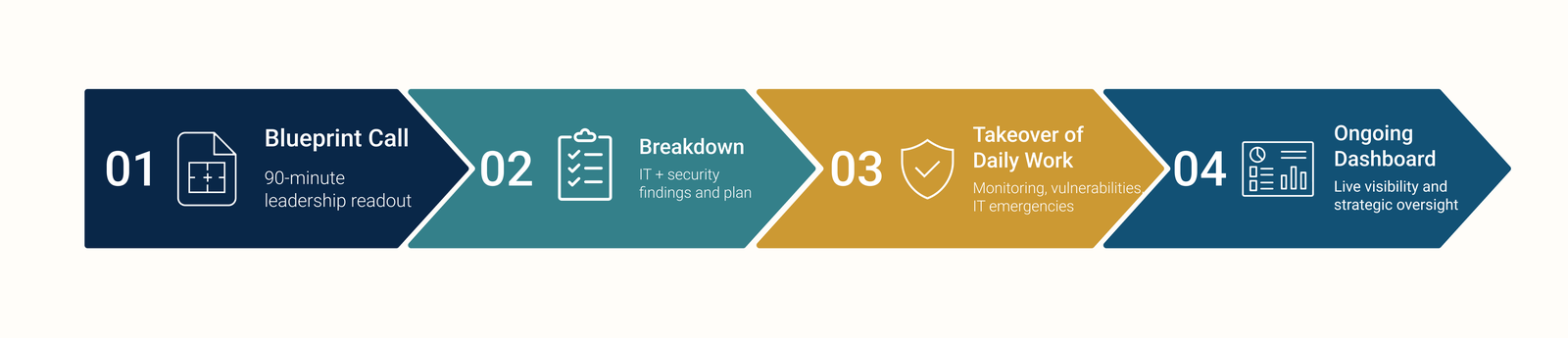
Consltek uses an IT Blueprint to create a structured view of the current environment.
The Blueprint covers four areas:
Current State: Infrastructure, applications, and existing technology.
Security: Security tools, risk gaps, and protection levels.
Operations: Processes, support status, and areas that need improvement.
Financial: IT spending, benchmarks, and opportunities to reduce waste.
The value is not the document itself.
The useful part is bringing information that usually lives in different places into one view so leadership can decide what happens next.
For a company that has grown through years of urgent IT decisions, that can answer several overdue questions:
What do we actually have?
Where are we exposed?
Which problems keep returning?
Who owns each issue?
Which spending still serves the business?
What needs to change before the next stage of growth?
Who Is Operational IT Management Built For?
Consltek works with growing organisations that have reached the stage where technology has become too important to manage informally.
Common situations include:
A business expanding to additional locations
A company adding cloud and SaaS applications quickly
An internal IT team carrying both operations and security
Leadership coordinating several technology vendors
A business facing customer security requirements
Companies preparing for audits or regulatory obligations
Organisations where recurring IT interruptions reach senior management
Consltek's current service model spans Managed IT Leadership, Managed Security, Managed Infrastructure, and GRC, allowing the operating view to extend beyond one technical area.
What Won't Good Operational IT Management Do?
There are a few things businesses should not expect from a serious IT operating model.
It should not recommend buying technology simply because a vendor has a new product.
It should not replace every working system for the sake of standardisation.
It should not leave the internal team wondering why decisions were made.
It should not treat every technical issue as equally urgent.
Good IT management should give the organisation enough information to make deliberate decisions.
Sometimes that means replacing a system.
Sometimes it means documenting what already works.
Sometimes it means removing something the company no longer needs.
What Does Better IT Management Feel Like for Leadership?
Go back to Dana.
The goal is not a world where nothing ever breaks.
Technology will fail. Vendors will have outages. Employees will make mistakes. Projects will introduce unexpected problems.
A better IT operating model changes what happens next.
Dana does not need to identify which vendor should take the call.
There is an owner.
She does not need to spend Saturday morning asking whether the problem affects customers.
The dependency is already documented.
She does not need to approve a rushed replacement because nobody knows what is currently installed.
There is a current-state view and a roadmap.
Eventually, the phone spends more Saturdays face-down on the counter.
That is a useful measure of operational IT management. Leadership can focus on the business because the technology environment no longer requires executive intervention every time something goes wrong.
Schedule your IT Blueprint conversation with Consltek and start building an IT operating model that can keep up with the business.
Ready to See What Your Technology Is Hiding?
To start somewhere, schedule a free IT Blueprint call with us. In 90 minutes, we'll help you see a clear picture of your IT untangling, where you stand, what's exposed, and what to fix first.
Operational IT management covers how technology is run day to day, including system ownership, support processes, vendors, security activities, infrastructure, documentation, costs, and recurring reviews.
Operational IT management focuses on keeping the current environment controlled, reliable, and visible. Strategic IT leadership looks further ahead at investment priorities, architecture, transformation, and how technology should support long-term business plans.
Review it when recurring IT issues reach senior leadership, responsibilities between vendors are unclear, software costs are difficult to explain, documentation is incomplete, or the business has grown significantly since the current setup was designed.
It can uncover unnecessary spending by reviewing licences, contracts, cloud usage, overlapping tools, and underused services. Any savings should come from verified findings rather than a generic percentage promised in advance.
Not necessarily. External expertise can work alongside an existing IT team by providing clearer ownership, documentation, vendor coordination, specialist capability, and leadership support.
Many security controls depend on normal IT processes. Better management makes access reviews, patching, backup testing, vendor oversight, onboarding, offboarding, and incident response easier to assign and track.
The dashboard should show information that supports decisions, such as critical-system health, recurring incidents, unresolved high-priority risks, recovery status, vendor problems, project progress, renewals, and significant budget changes.
Start with visibility. Document the critical environment, assign owners, map vendors and dependencies, identify major risks, review spending, and decide which problems should be addressed first.