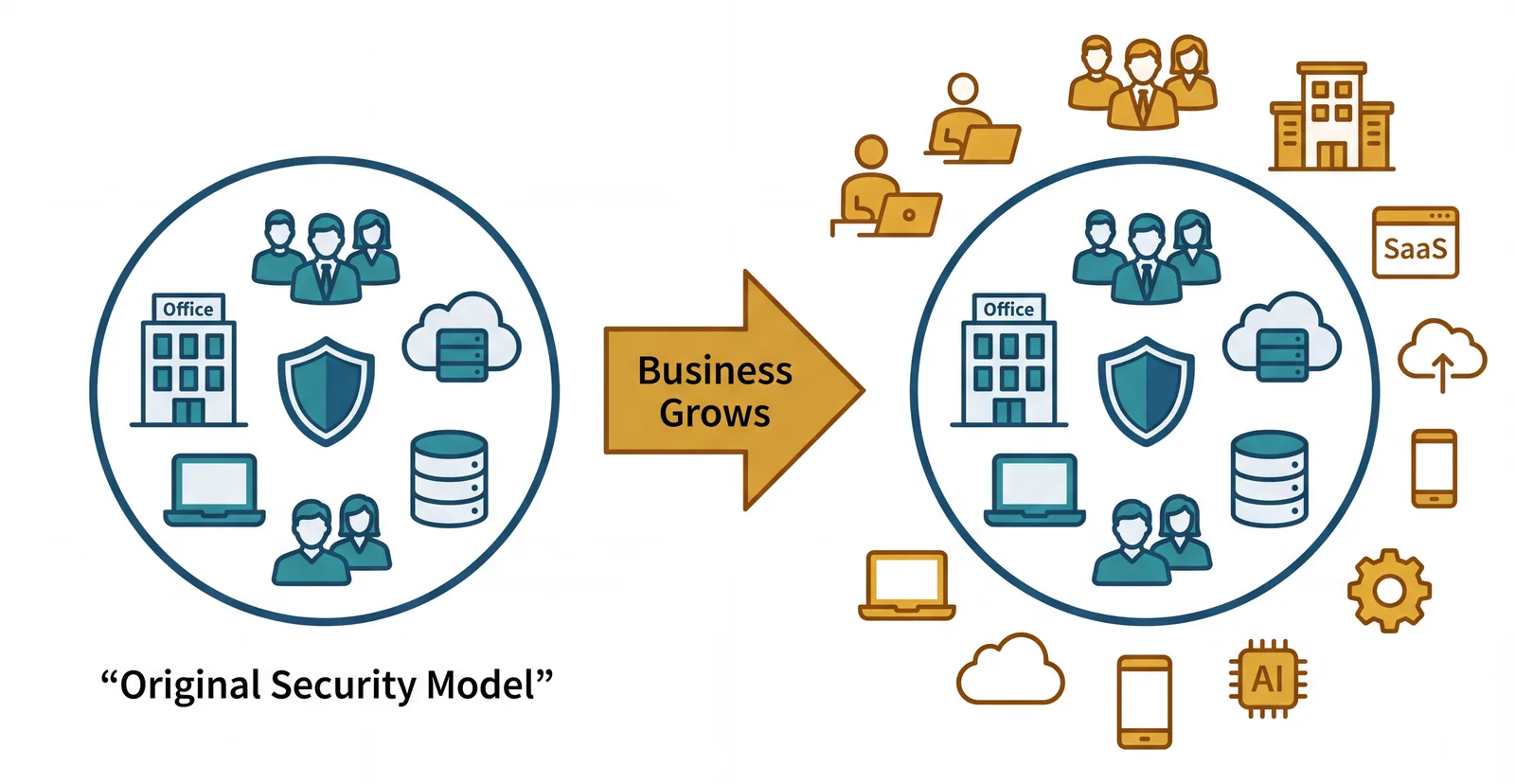
What if your company is not under-secured, but simply operating with a security model built for a smaller version of the business?
As the business grows, the environment changes quietly. More users, applications, vendors, devices, and access points get added over time, while the original security structure keeps stretching to accommodate them. Eventually, the harder problem is not adding protection. It is knowing whether the current model still reflects how the business actually operates.
Which risks matter most?
Who owns them?
Are tools overlapping?
Which systems are critical?
Can the business recover if something goes wrong?
That is the gap we are focused on solving. Our approach to managed security starts with the full picture through the IT Blueprint, then brings governance, control, and accountability around the risks that matter most.
The goal is not another dashboard. It is a security model leadership and IT can actually use.
When Did Cybersecurity Become Another Full-Time Job?
Nobody schedules a meeting to announce that the company has officially outgrown its cybersecurity setup.
It usually happens somewhere between the new office, the 40th SaaS application, the contractor who needed temporary access six months ago, and the employee who started using an AI tool because it saved 20 minutes on a report.
All of those decisions can be perfectly reasonable. Together, they can create a technology environment that looks very different from the one the original security plan was built to protect. Then leadership asks a question that sounds simple:
“Are we protected?”
The IT team knows the answer is rarely a clean yes or no. They need to know which systems are exposed, who still has access, what vendors can reach, which vulnerabilities matter most, what happens after hours, and whether yesterday’s successful backup can actually be restored.
That is where managed security services become relevant for a growing business. The goal is not to collect more cybersecurity products. It is to create a repeatable way to understand the environment, govern risk, investigate suspicious activity, assign ownership, and recover when something goes wrong.
Our Managed Security Services include vulnerability management, risk registers, employee security training, penetration testing, SASE, backup and restore, data protection, wireless security, and EDR/XDR. Those capabilities matter because of the outcomes they support, not because they add another acronym to the security stack.
What Is Our Managed Security Approach?
Our thesis is straightforward:
You cannot govern what you cannot clearly see. Security work has little value if it does not lead to a business outcome.
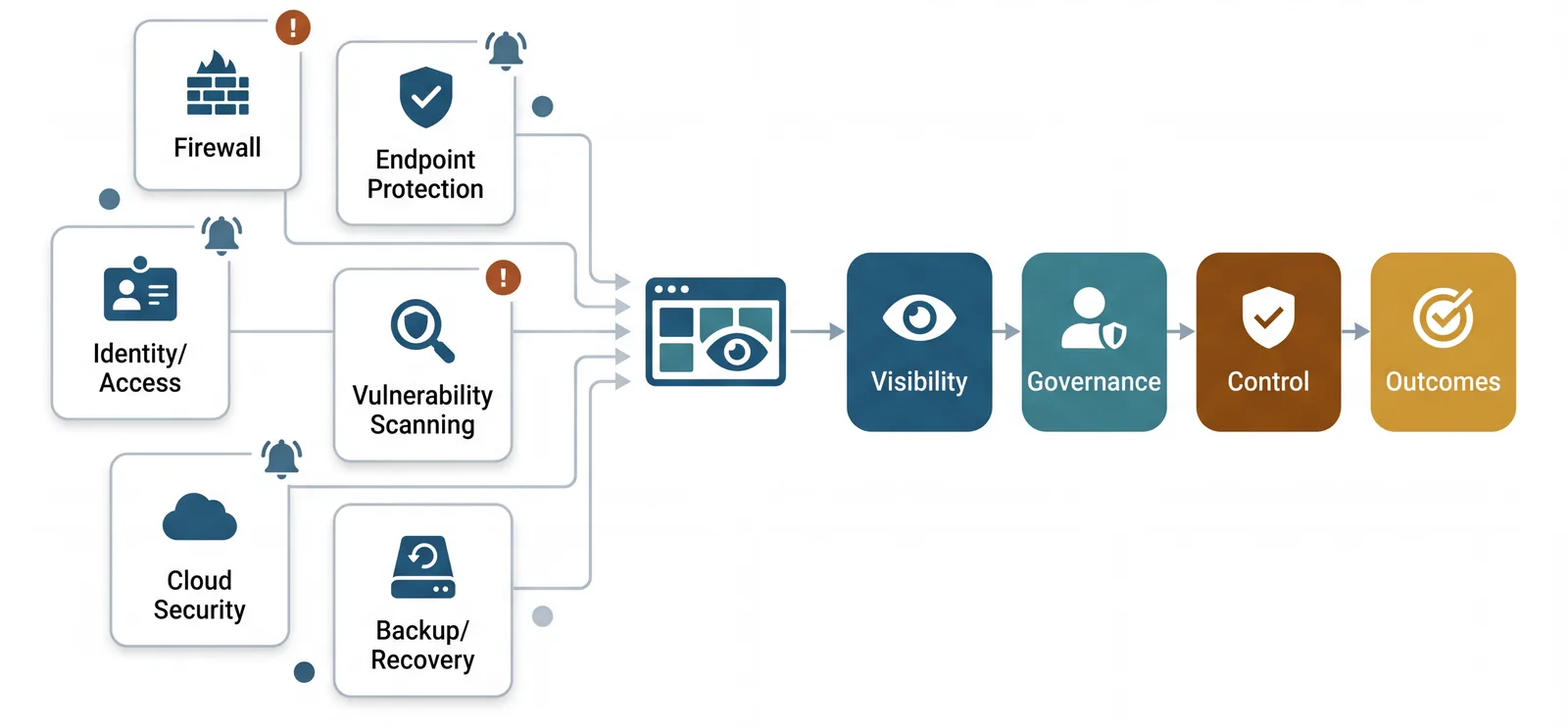
That is why we structure managed security around four stages:
Visibility → Governance → Control → Outcomes
We first establish what exists, what is exposed, what depends on what, and where technology spends money. From there, we help prioritize risk, assign ownership, apply the right controls, and measure whether security is actually improving.
This is also why we lead with our IT Blueprint rather than beginning with a product recommendation. The Blueprint creates a current-state view across infrastructure, security, operations, vendors, and spend so leadership can make decisions from one picture.
Why Does Security Start Falling Behind as a Business Grows?
Growth changes the environment faster than security processes usually change around it. Smaller companies may know most devices, users, applications, and vendors almost from memory. As the business expands, that informal visibility gets harder to maintain.
The CIO or IT Manager may now be dealing with:
More applications introduced by individual teams
More employees working across locations and devices
More vendor access to critical systems
Vulnerability findings growing faster than remediation capacity
AI tools entering workflows before governance catches up
Multiple providers managing different parts of the environment
Leadership still expecting one clear view of security risk
The pressure is not always a lack of technology. Often, it is the difficulty of connecting everything into one operating model.
The firewall provider knows the firewall. The endpoint provider knows endpoints. The SaaS vendor knows its application. Internal IT is left trying to connect the dots and explain the outcome.
That is where we work as a trusted technology advisor, not another provider handing over another dashboard.
Can your leadership team see the same security picture your IT team sees?
If the answer depends on five dashboards, three vendors, and somebody’s spreadsheet, start with the current state first.
Buying another security product can feel like progress because something tangible changed. A new dashboard appears. Another agent gets deployed. Another vendor starts sending reports.
Yet the CIO may still have the same questions three months later. Which exposure should we fix first? Who owns it? Are multiple products doing the same job? Which controls are actually working? That is why we do not start with the assumption that the answer is another tool.
A business can have an impressive security stack and still lack governance. It can own five products that identify risk while nobody owns closing it.
More tools can create more noise. Better visibility creates better decisions.
What Are IT Managers and CIOs Actually Struggling With?
The challenge is rarely just technical.
An IT Manager may spend the morning reviewing endpoint alerts, the afternoon helping with a migration, and the next day answering a customer security questionnaire. At the same time, leadership expects the environment to remain available, secure, and cost-effective.
What Leadership Asks
What IT May Actually Be Dealing With
Are we secure?
Security information spread across several tools and vendors
What should we fix first?
Hundreds of findings with limited remediation capacity
Who owns this risk?
Responsibility split across IT, operations, vendors, and leadership
Can we recover?
Backups exist, but restore testing is inconsistent
Are we audit-ready?
Evidence lives across emails, spreadsheets, and systems
Are employees using AI safely?
New tools appear faster than governance reviews
Why is security spend increasing?
Overlapping licenses, tools, and contracts
Why are we still firefighting?
Operational work leaves little room for improvement
The team does not need another place to look. It needs a clearer operating model.
What Is the Consltek Managed Security Model?
Our managed security model follows a simple progression: see the environment clearly, govern what matters, apply the right controls, and measure the outcome. We use the IT Blueprint to establish the current state first, so decisions are based on the business, existing technology, and actual risk rather than assumptions or product recommendations.
Stage
What We Do
Business Outcome
Visibility
Map systems, identities, security tools, vendors, dependencies, and spend
Leadership sees the current state
Governance
Prioritize risk, assign owners, define policies, and establish decision paths
Security work stops falling between teams
Control
Apply the right safeguards based on the Blueprint
Controls match actual exposure
Outcomes
Measure remediation, resilience, response, and readiness
Security becomes easier to manage and defend
This is where our approach differs from a traditional MSSP model.
We do not begin with, “Which security product can we sell?”
We begin with, “What does your environment look like today, where are the gaps, and which outcomes should improve first?”
How Should Every Security Capability Connect to an Outcome?
Managed security should not read like a product catalogue. Every capability needs to answer a business question.
Capability
Business Question
Outcome
Vulnerability management
What needs fixing first?
High-impact exposure moves toward closure
EDR/XDR
What is happening across endpoints and systems?
Faster investigation and better incident context
Security training
Will employees recognize and report risky activity?
Fewer preventable human-driven gaps
SASE
How do we secure users wherever they work?
Consistent access and simpler oversight
Backup and recovery
Can critical systems be restored?
Tested operational resilience
Penetration testing
Can an attacker actually use the weakness?
Real attack paths are validated
Risk management
Who owns each important risk?
Clearer accountability
AI governance
How do we use AI without losing control of data?
Safer AI adoption
The capability matters because of the outcome behind it.
Why Is Vulnerability Management a Governance Problem?
Imagine receiving a report with 1,200 findings. The scanner has done its job. The IT team still has patch windows, system owners, operational dependencies, customer commitments, and other work competing for the same time. That is where prioritization becomes more important than discovery.
The 2026 Verizon DBIR found that 31% of breaches began with vulnerability exploitation, putting vulnerability exploitation ahead of stolen credentials as the leading initial access route in the report’s dataset. A mature vulnerability process therefore needs business context.
Is the issue actively exploited? Is the affected system internet-facing? Is it critical to operations? Who owns the remediation?
Our Vulnerability Scanning approach combines recurring assessment with review and prioritized remediation guidance. The outcome is not simply more findings. It is a smaller list of risks that deserve action first.
What if your scanner finds 1,200 vulnerabilities before lunch?
The real question is not how many findings exist. It is which five could affect the business first.
Detection technology is useful when it shortens the path from “something looks unusual” to “we know what happened and what needs action.”
CrowdStrike’s 2026 Global Threat Report found that the average eCrime breakout time fell to 29 minutes in 2025, with the fastest observed breakout taking only 27 seconds. The report also found that 82% of detections were malware-free. That is why modern detection needs context.
Our EDR/XDR service combines endpoint monitoring with broader telemetry, threat hunting, containment, and incident-response support. The business outcome is faster investigation and fewer hours spent trying to connect unrelated alerts manually.
For the CIO, the important question is not whether EDR is installed. It is whether the organization can recognize what needs attention quickly enough to make a decision.
How Does Managed Security Support a Distributed Workforce?
The office used to be an easy place to draw a security boundary. Today, users may work from home, branch locations, airports, client sites, and other networks while critical applications sit in the cloud.
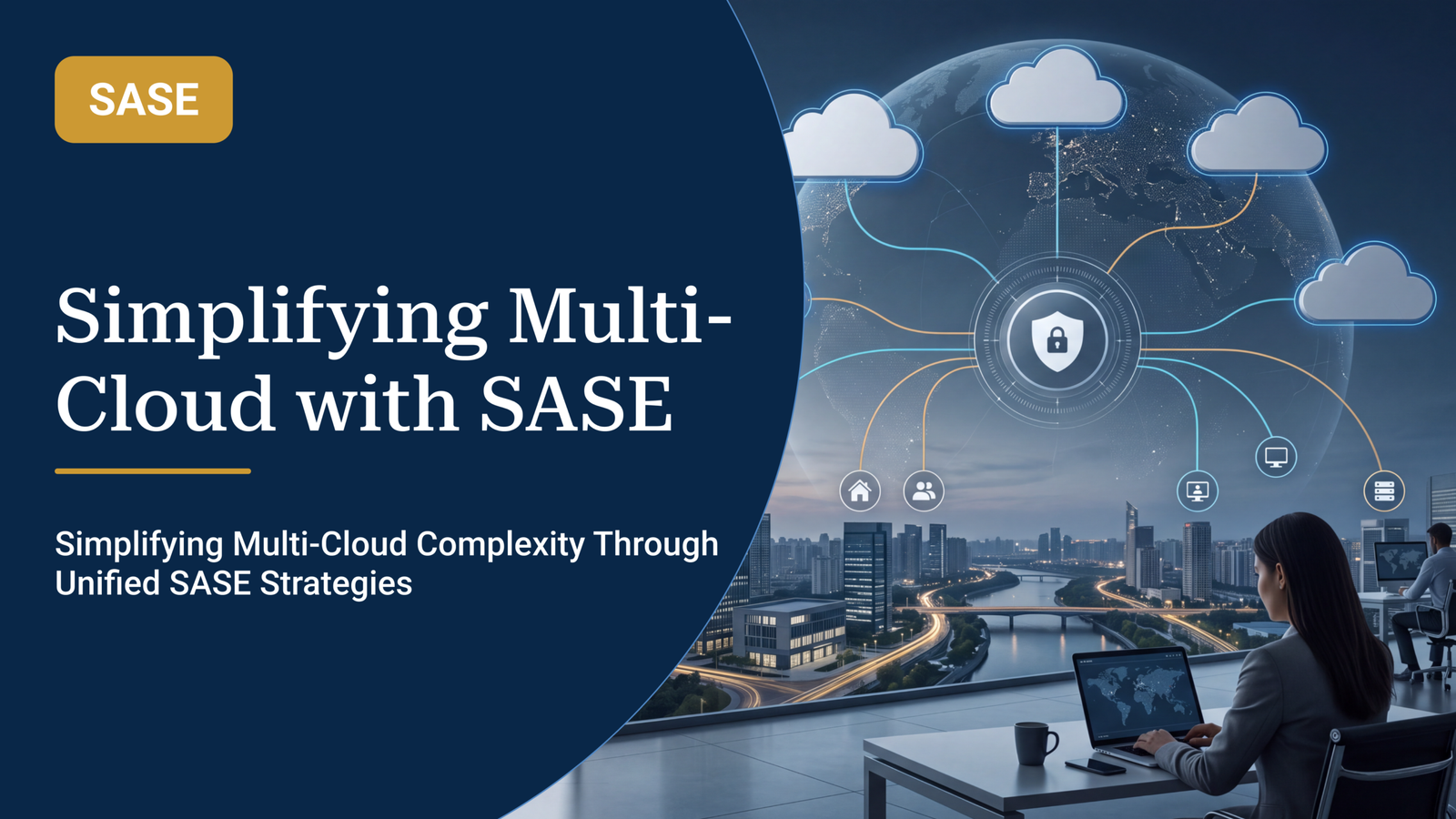
Our SASE approach brings networking and security functions into a cloud-delivered architecture. The outcome is more consistent access control and simpler oversight across users, devices, and applications. The conversation should not begin with SASE as a product category.
It should begin with a business question: Can the company add a new user, location, or application without rebuilding security every time?
Backups Are Not the Same as Recovery
A successful backup job does not automatically mean the business is ready to recover. Leadership needs to know whether critical systems are protected, whether copies are isolated appropriately, how quickly systems can be restored, and whether the process has been tested.
Our Backup and Restore services include automated protection, geographic redundancy, immutable storage, granular recovery, and restore testing.
The business outcome is straightforward. The company should know what comes back first, who owns the recovery, and how much interruption it can realistically tolerate.
How Should Growing Businesses Think About AI Security?
AI adoption is another example of technology moving ahead of governance.
Employees may use AI for proposals, research, meeting notes, spreadsheets, development, and customer work before IT has reviewed every tool.
IBM’s 2025 Cost of a Data Breach research found that 63% of breached organizations studied lacked AI governance policies, while organizations with high levels of shadow AI saw an additional $670,000 in average breach cost. The answer is not to block useful AI adoption.
The better approach is to establish visibility into what employees are using, define approved tools, govern identities and integrations, and set clear rules around sensitive data.
That follows the same thesis again: Visibility first. Governance next. Outcomes after that.
What Does This Look Like in a Real Consltek Engagement?
Cleveland University Kansas City provides a useful example because the challenge was not simply a shortage of technology.
The university supports more than 1,000 students and 800 faculty and staff, alongside a clinic. As distance learning, remote work, cloud services, and hybrid infrastructure expanded, the internal IT organization faced staffing pressure, multiple vendors, fragmented services, rising costs, and growing security requirements.
We streamlined IT operations, enhanced network services, provided 24/7/365 managed support, introduced a SASE security solution, and worked as an integrated extension of the university’s team.
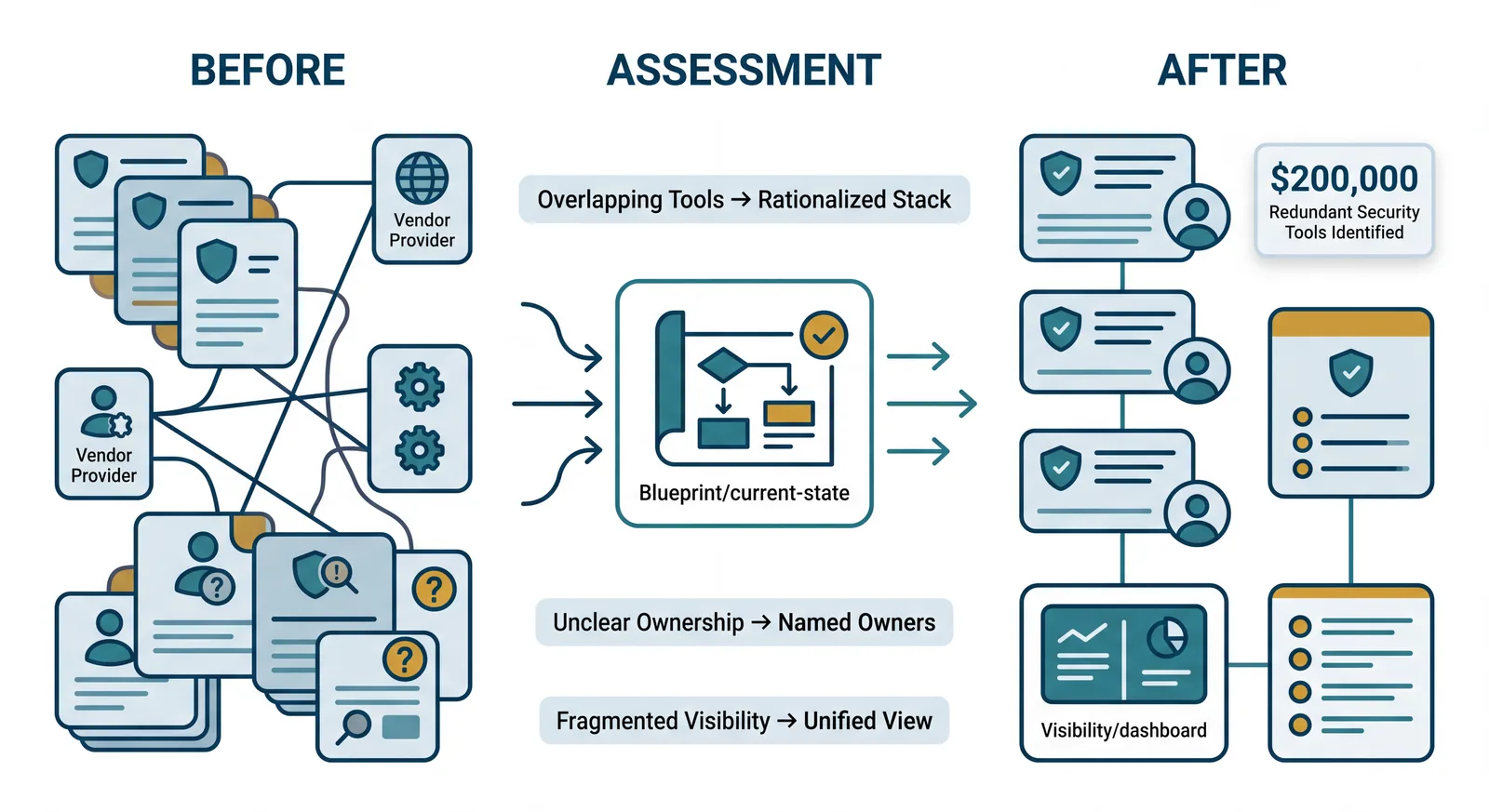
The more revealing finding came from looking across the existing security environment. Our assessment identified $200,000 in redundant security tools while giving the university greater visibility into the overall security posture.
The important result was not simply that another security control was introduced. The university gained a clearer view of what already existed, where tools overlapped, which risks required attention, and where technology spending could be simplified.
The customer became more capable. Our role was to help make the path clearer.
What Should You Look for in a Managed Security Partner?
A strong managed security partner should make the environment easier to understand and operate.
Do they start with discovery?
The partner should understand your users, infrastructure, vendors, controls, spend, and business priorities before recommending what needs to change.
Can they explain risk in business language?
Leadership needs to know what could affect customers, operations, growth, cost, or compliance. A technical finding should not stay trapped inside a technical report.
Do they help close the gap?
Finding a vulnerability is only half the work. Ask how ownership, remediation, and follow-up are handled.
Can they work alongside your existing team?
A trusted partner should strengthen the operating model rather than create another silo.
Are recommendations independent?
The architecture should fit the environment, not a reseller target.
Can they show outcomes?
Reports should show what improved, what remains open, who owns the next step, and where leadership needs to make a decision.
If the conversation is mainly about alerts, licenses, and dashboards, the focus may still be too narrow.
Does your current security partner tell you what happened, or help you decide what happens next?
The difference between monitoring and trusted advisory is what happens after the alert, finding, or risk appears.
How Do You Know the Current Security Model Is Falling Behind?
The warning signs usually appear in everyday work.
Warning Sign
What It May Be Telling You
Alerts stay open for days
Monitoring capacity is not matching the environment
Vulnerability reports keep growing
Discovery is outrunning remediation
Nobody trusts the asset inventory
Security coverage may be incomplete
Several vendors own separate controls
Accountability is becoming unclear
Audit preparation becomes a scramble
Governance is reactive
Employees adopt tools before review
Technology adoption is outpacing policy
Privileged access is hard to explain
Identity governance needs attention
Backups succeed, but restores are rarely tested
Resilience is assumed rather than proven
IT spends most of its time firefighting
Strategic improvement keeps getting pushed back
Leadership cannot get one risk view
Security data exists, but governance is missing
One or two of these issues can happen in any company. When several become normal, the problem is usually bigger than a missing tool.
The operating model has fallen behind the business.
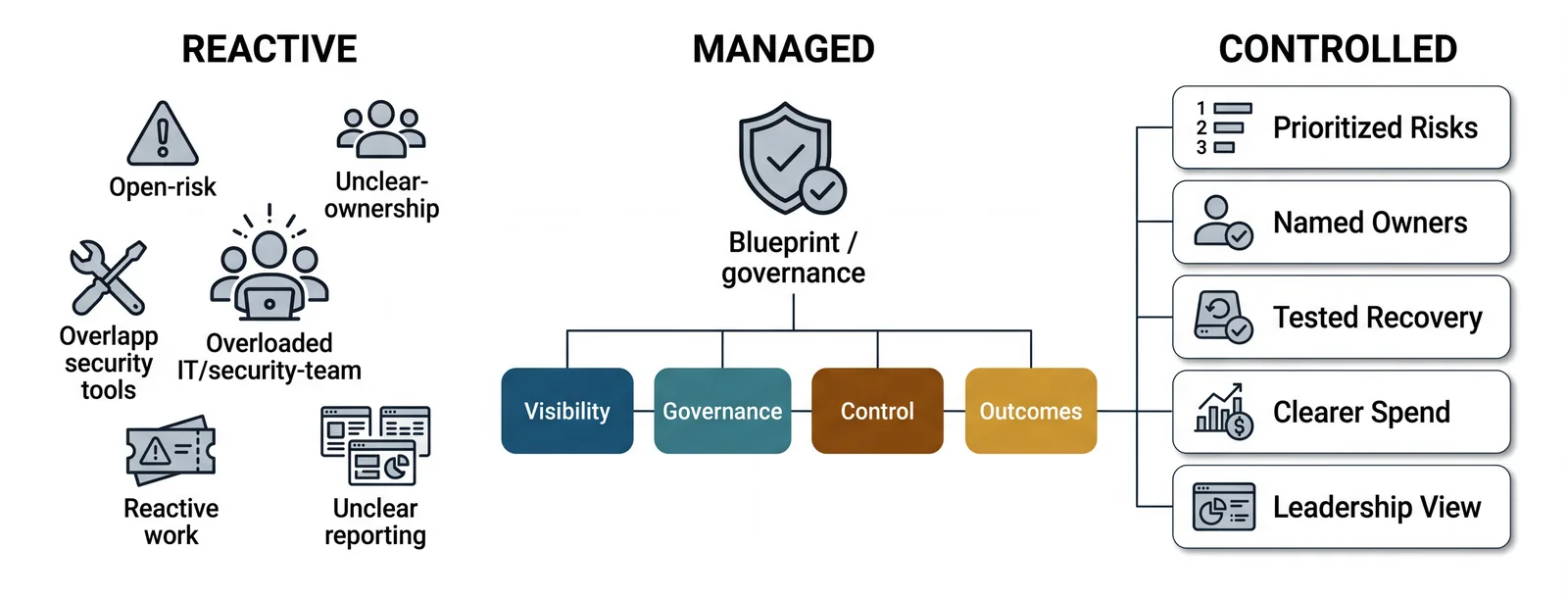
From Security Activity to Security Control
A good managed security relationship should become easier to explain over time. Leadership should know where the business is exposed, which risks deserve attention, and whether the overall posture is improving. The IT team should know who owns remediation and should spend less time stitching together answers from disconnected providers.
The outcomes should show up in practical ways:
Critical risks move toward closure
Security spending becomes easier to defend
Incident investigation becomes faster
Recovery readiness is tested
Compliance evidence is easier to produce
Vendor and AI risk have clearer governance
Leadership gets a security view it can actually use
That is what managed security is supposed to deliver. Not more security noise. More control.
Managed Security Should Start With a Better Question
The usual question is: “Which security service do we need?”
For a growing business, there is a better place to start.
“What does our security environment actually look like today, where are we exposed, and what outcome needs to improve first?”
That question changes the conversation. It moves managed security away from buying tools in isolation and toward a governed operating model where leadership has visibility, IT has clearer ownership, and every control has a reason for being there.
That is the role we are built to play. We are not here to become another MSSP watching one piece of the stack. We are here to help the business see the full picture, govern the risks that matter, and turn security work into outcomes leadership can measure.
See what you have, where the real risk is, where tools overlap, who owns the next action, and which improvements should come first.
Start with your IT Blueprint and build the next stage of security around the business you are becoming.
Start with the current state. Identify critical systems, users, vendors, existing security tools, major risks, and technology spend before deciding what additional controls are required.
We begin with the Blueprint and look across the entire technology and risk environment before recommending changes. The focus stays on governance, ownership, and measurable business outcomes rather than adding another monitoring provider.
No. Our model can support and extend internal leadership. The goal is to give the existing team more security capacity, better visibility, and clearer ownership without creating another silo.
A current-state review can uncover overlapping licenses, redundant products, and controls that are not aligned with actual risk. In our Cleveland University engagement, we identified $200,000 in redundant security tools while improving visibility into the environment.
Priority should consider exploitability, exposure, system criticality, business impact, and existing controls. A severity score alone should not determine the remediation order.
Yes. Continuous governance creates evidence around vulnerability remediation, access controls, training, risk reviews, and recovery testing before an auditor or customer asks for it.
Often, yes. The issue may not be a lack of technology. The bigger question is whether existing controls are mapped, governed, monitored, and producing the outcomes the business expects.
Start with our IT Blueprint. It establishes the current state across security, operations, infrastructure, vendors, and spend so leadership can decide what should happen next based on evidence rather than another product pitch.